UGC Killed the CARE List. Who Is Checking Your Journals Now?
· ORBIXER AI LABS
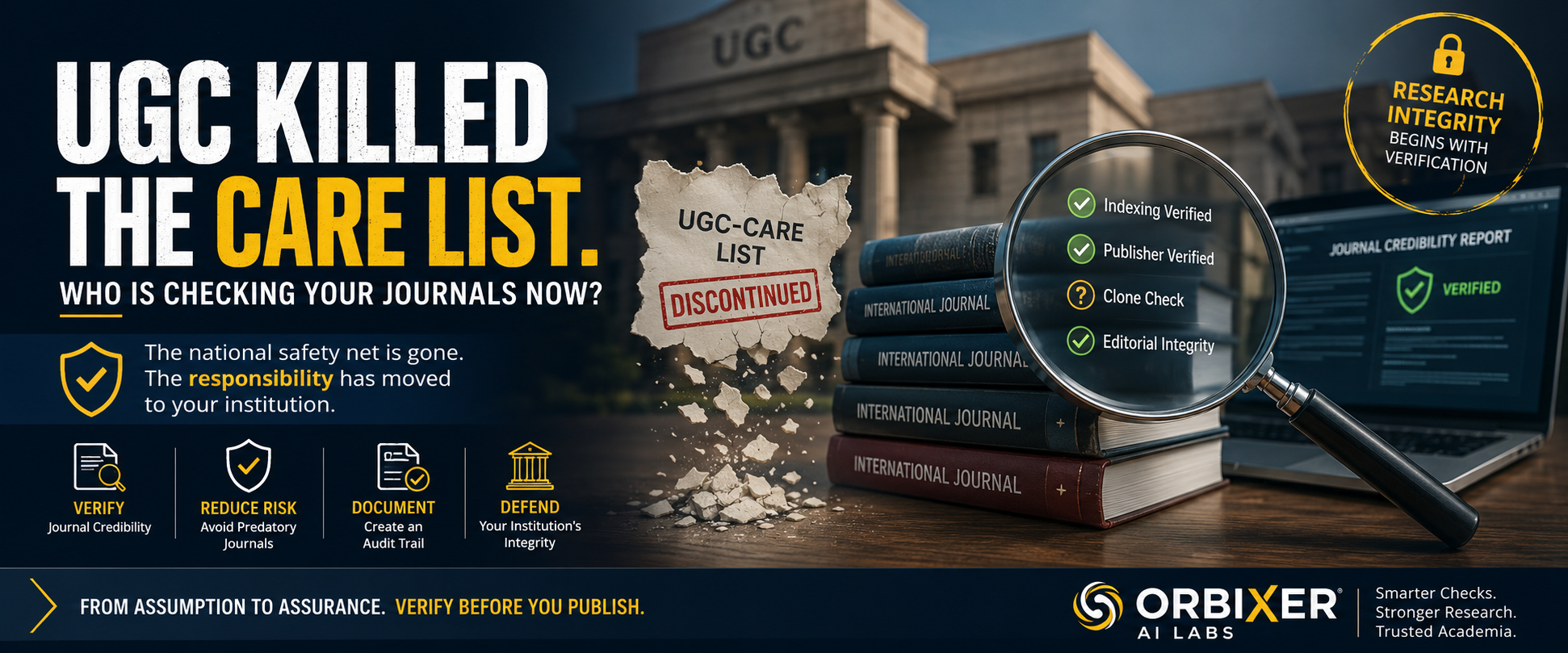
For years, Indian academia had a simple answer to a difficult question:
"Is this journal credible?"
Check the UGC-CARE list.
If the journal appeared on the list, researchers had a nationally recognized reference point. Faculty used it. PhD supervisors advised scholars to check it. Promotion committees considered it. Institutions relied on it while dealing with academic and accreditation-related requirements.
It was not perfect.
But it was simple.
And, perhaps most importantly, it gave everyone a common reference point.
Then the list disappeared.
And the question remained.
The List Disappeared. The Risk Didn't.
In October 2024, the UGC discontinued the CARE journal list and instructed higher-education institutions to develop their own mechanisms for assessing journal quality.
The stated reasoning included concerns about over-centralization and the treatment of regional-language journals.
But removing a national list created a much bigger institutional question:
Who verifies journal quality now?
The answer is no longer a central list.
The institution does.
That is a fundamental change.
The old mental shortcut —
"Check whether the journal is on CARE."
— is no longer valid.
There is no replacement CARE list waiting around the corner.
The responsibility has moved from the centre to individual institutions.
And responsibility without a reliable system quickly becomes institutional risk.
One Decision Changed the Rules of Indian Publishing
Before October 2024, the process was relatively straightforward:
Researcher → UGC-CARE → Journal status → Institutional decision
A faculty member or research scholar had a common national reference point.
After October 2024, the structure changed:
Researcher → Institution → Institutional mechanism → Journal assessment → Decision
Now institutions must determine what they consider an acceptable journal and how that decision is made.
That creates a fundamentally different question.
Previously, an institution could point to a national list.
Today, an institution may eventually be asked:
"Why did you accept this journal?"
That question requires more than an answer. It requires evidence.
What was checked? Which databases were consulted? Was the publisher verified? Were indexing claims confirmed? Was the journal website authentic? Was there any indication of a cloned or hijacked journal?
And most importantly: was the decision documented?
"Design Your Own Mechanism" — Easier Said Than Done
On paper, asking institutions to create their own journal-quality mechanism sounds reasonable. In practice, it creates a serious capability challenge.
Because journal verification is not simply asking: "Is this journal indexed?"
A meaningful assessment may involve checking several independent signals. For example:
Is the claimed indexing genuine?
Is the publisher legitimate?
Is the editorial information authentic?
Does the journal belong to the claimed publisher?
Is the website genuine?
Could it be a cloned or hijacked journal?
Does the journal have a credible publishing history?
Are its claims consistent with recognized databases?
And then comes the biggest practical question: who has the time and expertise to perform these checks at scale?
The old CARE system had one major advantage that is easy to underestimate: it was fast. A researcher could check one list in seconds.
Without a centralized reference point, verification can become a manual investigation. Manual investigation is difficult. Manual investigation across hundreds or thousands of publications is even harder. And manual systems rarely scale.
A Journal Can Look Real — and Still Be a Trap
This is where the problem becomes more serious. A questionable journal does not always look questionable. It may have:
A real ISSN.
A professional website.
An impressive editorial board.
International-looking indexing logos.
A convincing publisher name.
A long list of published papers.
Everything may appear legitimate at first glance. But appearance is not verification.
A journal can claim an index without actually being indexed. A website can resemble the website of a legitimate publication. A researcher may see the right terminology and assume the journal has been verified.
That is precisely why institutional journal assessment cannot depend only on appearance or informal searches.
Three Places Where the System Can Break
The consequences are not theoretical. They can appear at multiple points in the academic ecosystem.
1. The PhD Thesis
A research scholar submits a thesis containing three publications. The journals look legitimate. They have ISSNs. They have professional-looking websites. They display editorial boards. They claim indexing.
But has anyone actually verified those claims? Has anyone checked whether the journal is genuinely indexed? Has anyone checked whether the publisher is legitimate? Has anyone checked for a clone or hijacked journal website?
If not, the thesis may move forward on trust rather than verification. The problem is not the scholar. The problem is the absence of a reliable institutional process.
2. The IQAC Office
Now imagine a NAAC visit. An assessor asks: "How does your institution ensure the quality of journals in which faculty publish?"
The institution needs more than an informal answer. It needs a process. What databases are checked? Who performs the verification? What criteria are applied? How is the decision recorded? Can the institution produce evidence if the decision is questioned?
If the answer is "our departments check journals individually," the institution may have a practice. But does it have a documented mechanism? That distinction matters. An informal process can look perfectly adequate — until someone asks for the paper trail.
3. The Promotion Committee
Now consider a promotion or recruitment committee. A candidate meets the required publication count. But several journals are unfamiliar. The committee has limited time. Nobody wants to spend hours manually investigating every journal.
So the discussion can gradually shift toward "how many papers has the candidate published?" instead of "how credible are the journals in which those papers were published?" That creates a familiar academic risk: quantity begins to overshadow quality. And that is precisely the kind of problem journal-quality systems were intended to reduce.
Three Questions Every IQAC Director Should Answer — Today
If UGC or NAAC asked your institution tomorrow, "how do you assess journal quality?" — could you answer confidently?
1. What Exactly Do We Check?
What does your institution consider when evaluating a journal? Indexing? Publisher legitimacy? Journal identity? Editorial information? Website authenticity? Clone or hijacked-journal risk? A credible institutional policy should define its criteria clearly.
2. Who Verifies It — and How?
Does the responsibility sit with the department, the supervisor, the research committee, the IQAC, the library, or a designated research office? And what exactly does that person or office check?
If every verification depends on a manual Google search, the process may eventually be skipped because of time pressure. That is not necessarily a people problem. It is a system-design problem.
3. Where Is the Evidence?
This may be the most important question. Can the institution show what was checked, when it was checked, what evidence supported the decision, who performed the assessment, and what conclusion was reached?
Because there is a major difference between "we usually check journals" and "here is our documented journal-quality assessment process." The first is a statement. The second is a mechanism.
Your Institution Needs More Than a "Yes" or "No"
A serious journal-quality mechanism should not simply produce a verdict. It should make the decision understandable and defensible. At minimum, an institutional system should be able to do four things.
1. Verify Journal Legitimacy Quickly
The process should help assess indexing status, publisher credibility, journal identity, editorial information, and clone or hijacked-journal risk — within the time faculty and committees actually have.
2. Create an Audit Trail
A decision should leave behind evidence. Not just "approved," but "approved because these checks were performed and these signals were verified." That creates a much stronger institutional record for internal review and accreditation-related documentation.
3. Include the Indian Research Ecosystem
Indian academia is not limited to a handful of major international databases. Regional-language journals and India-specific scholarly ecosystems also matter. Any institutional mechanism should recognize that reality rather than simply reproduce the limitations of the old system.
4. Scale Beyond Individual Spot Checks
A university may have hundreds or thousands of faculty publications. A process that works only when someone manually investigates one journal at a time will struggle to survive at institutional scale. The future requires structured verification, not endless manual checking.
This Is Where ORBIXER Comes In
This is precisely the gap ORBIXER Verify is designed to address.
ORBIXER Verify currently provides individual journal credibility checks covering areas such as indexing status, publisher tier, and clone or hijacked-journal risk. The objective is straightforward: make journal verification faster, clearer and more defensible.
But research integrity also means being precise about what a product does today. ORBIXER is not presenting institution-wide portfolio screening or structured NAAC/NIRF reporting as already-shipped features. Those capabilities are under active development.
Today, ORBIXER Verify is focused on answering a more immediate question: "How do I check the credibility of this journal before I publish?" That is the problem ORBIXER Verify is built to help solve today. The institution-wide verification and reporting layer is the next step.
What Institutions Can Do Right Now
The disappearance of the CARE list does not mean institutions are powerless. It means they need to build their own capability.
For Vice Chancellors & Research Deans
Ask the uncomfortable question: "Do we have a documented institutional mechanism for journal-quality assessment — or are we still informally relying on a list that no longer exists?" Treat this as an institutional research-integrity issue, not simply an administrative task.
For IQAC Directors
Start building a written journal-quality assessment policy. Define what your institution checks, which sources are considered, how publisher legitimacy is assessed, how questionable journals are handled, who is responsible for verification, and how evidence is recorded. Build the paper trail before the accreditation visit asks for it.
For Faculty & PhD Supervisors
Stop advising scholars, "check whether the journal is on CARE." That advice belongs to a system that no longer exists. Instead, teach researchers how to verify indexing, publisher, journal identity, and credibility before submission.
For Research Scholars
Do not assume that a professional-looking journal is automatically a credible journal. Do not rely solely on claims displayed on the journal's own website. Before submitting your manuscript: verify. Because your publication record becomes part of your academic identity.
The Bigger Shift
The real story is not simply that the UGC-CARE list disappeared. The bigger story is what happened to the responsibility after it disappeared.
For years, journal-quality assessment was largely treated as a centralized problem. Now it has become an institutional capability problem.
Every university will eventually need to answer three questions: What is our standard? How do we apply it? Can we prove that we applied it?
The institutions that start answering these questions now will be better prepared than those waiting for another centralized list to appear.
Because the important question is no longer "is this journal on CARE?" The important question is "can we prove this journal is credible?" And that is a much more important question.
The CARE List Is Gone. Responsibility Isn't.
The era of simply pointing to a national journal list is over. The next era requires something more difficult: institutional judgment, documented verification, research integrity, accountability — and technology that can help institutions and researchers make those decisions faster and more systematically.
Verify Before You Publish
ORBIXER AI LABS is building research-integrity and journal-credibility technology for Indian higher education. If your institution is developing its own journal-quality mechanism — or if you are a researcher who wants to verify a journal before submission — ORBIXER Verify is built to help you take that first step.
The CARE list may be gone. The responsibility isn't.
ORBIXER AI LABS
Research Integrity. Journal Credibility. Smarter Publishing.
Sources
Scroll.in, "Class, caste, collapsing public universities: Why Indian researchers publish in predatory journals," November 2025
Wikipedia / The Telegraph (India), "Quality alarm as UGC scraps journal list, global standing of Indian universities to be affected," January 2025
ThePrint, "UGC says publishing paper in de-recognised journals will affect promotion & appointment"
Editage Insights, "India cancels hundreds of predatory journals"