The Midnight Crucible: Why Artificial Intelligence is Becoming Essential for the Modern University Professor
· ORBIXER AI LABS
The Silent Hour of the Academy
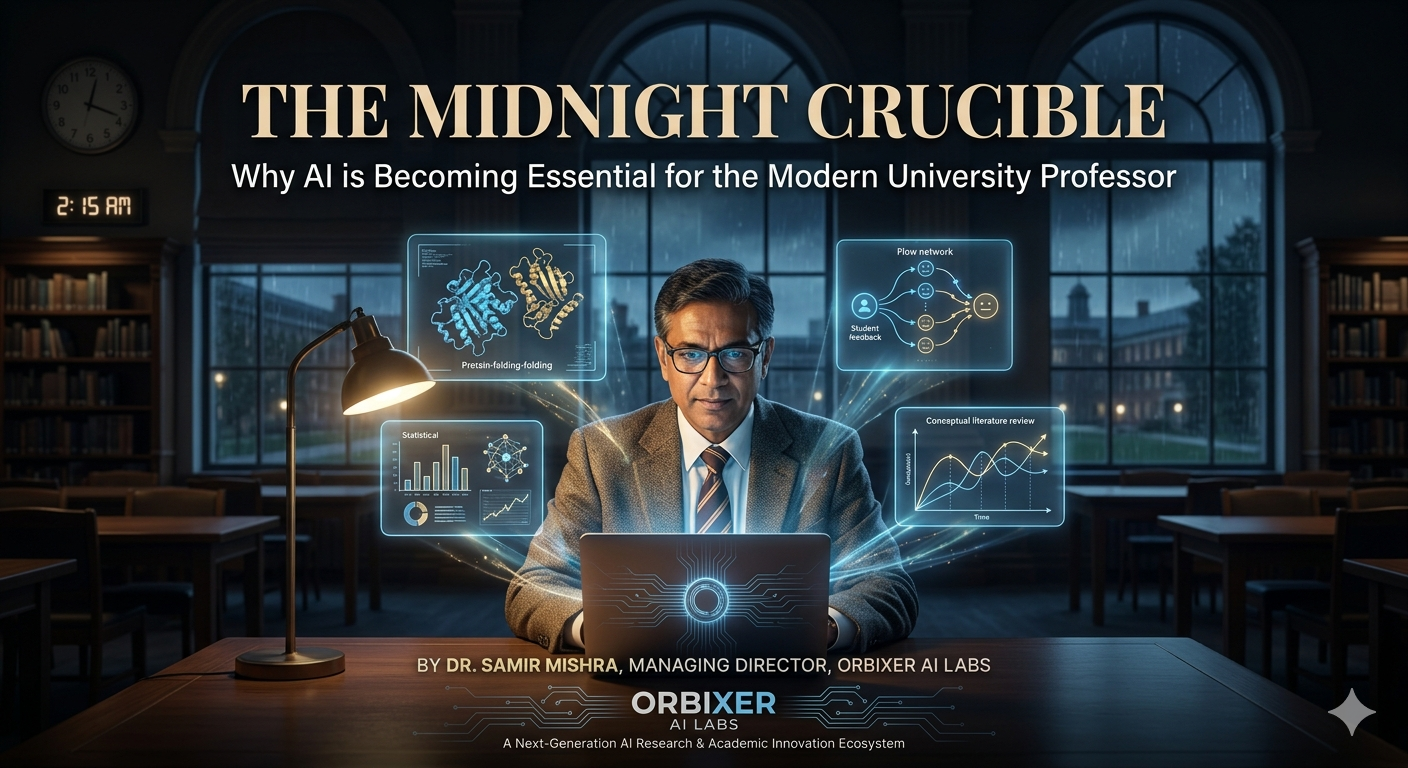
The clock on the office wall chimes 2:15 AM. The rhythmic ticking is the only sound breaking the silence of an otherwise deserted university hall. On the mahogany desk, a laptop screen glows with an almost predatory brightness, casting long, sharp shadows across stacks of un-graded midterms, printed journal proofs, institutional accreditation files, and a half-empty cup of cold coffee.
Professor Elena Vance rubs her temples. Her eyes burn with the distinct, gritty ache of chronic exhaustion. Tomorrow morning—or rather, in less than six hours—she must deliver a flawless, high-energy lecture on quantum materials to ninety undergraduate students.
But her immediate reality is far removed from the sublime beauty of her science.
Instead, she is drowning. She is caught in a relentless, suffocating matrix of modern academic administrative demands. She must manually respond to forty-two unread student emails, format a eighty-page grant proposal according to an aggressively specific institutional template, cross-reference data points for an upcoming accreditation audit, and review a doctoral student’s draft that requires extensive linguistic refinement.
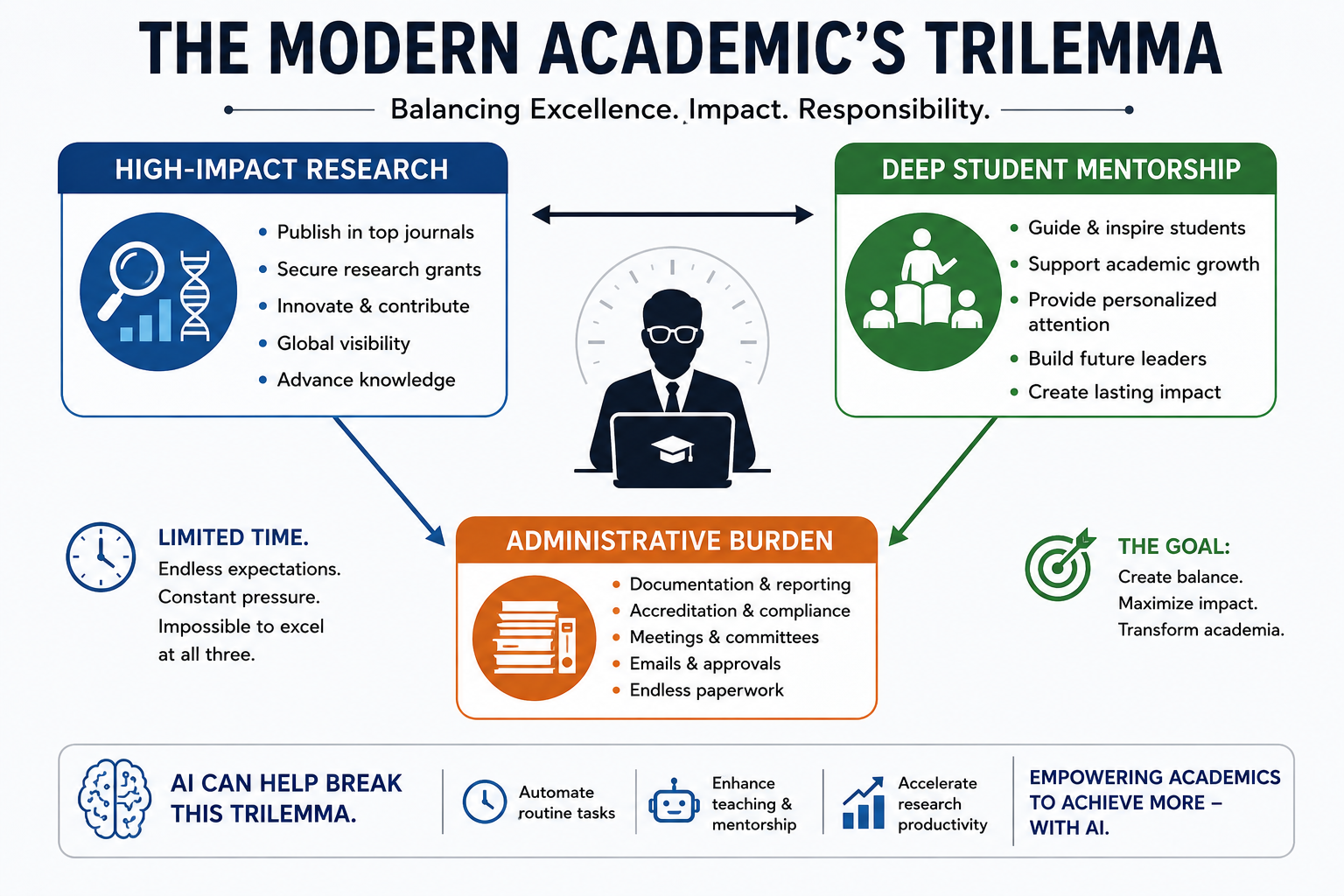
Every modern educator recognizes this silent crisis. The contemporary professor is no longer just a vessel of knowledge or a pioneer of discovery. They have been involuntarily transformed into a data-entry clerk, an administrative coordinator, an entry-level editor, and a round-the-clock support desk. The tragedy of this evolution is not merely the exhaustion of the individual; it is the systematic starvation of human genius. The hours spent wrestling with bureaucratic minutiae are hours stolen from breakthrough insights, deep student mentorship, and true intellectual exploration.
Then, Elena clicks open a new tab. It is a specialized, secure AI research and academic innovation platform. She uploads her raw, unstructured laboratory notes from the past quarter and issues a precise command. Within ninety seconds, the system synthesizes the disparate data, surfaces three hidden statistical correlations she had intuitively sensed but had not yet proven, generates a pristine, publication-grade visualization of the molecular matrices, and drafts a comprehensive literature review referencing forty peer-reviewed papers published across Europe and Asia within the last forty-eight hours.
Elena leans back in her chair. The heavy weight in her chest lifts, replaced by a sensation she hasn't felt in nearly a decade: pure, unadulterated intellectual wonder.
She is not looking at a software tool. She is looking at an intellectual mirror—an amplifier that has just returned to her the most precious, non-renewable resource in the universe: time.
This is not a distant, speculative future. This is the dawn of the augmented academy. We are witnessing a profound structural mutation in higher education. Artificial Intelligence is transitioning from an exotic technical novelty into an essential existential partner for the modern university professor.
The question sweeping through the halls of global universities is no longer whether AI will alter the educational landscape. The true question is whether individual educators will choose to become the architects of this new cognitive era or remain the casualties of an obsolete paradigm.
The Industrialization of Enlightenment: The Architectural Failure of the Past
To understand the magnitude of the current shift, we must look at the traditional academic framework with clear, unsentimental eyes. For over two centuries, the university model has operated on a foundational paradox: it demands cutting-edge, visionary thought from its faculty while forcing them to work within an archaic, industrial-era operational framework.
For decades, the journey of an academic was defined by friction. Consider the classic process of producing a single peer-reviewed research paper. It was an exercise in systematic endurance:
The Manual Archive Drag: Spending weeks navigating physical library stacks or fragmented digital repositories, cross-referencing indexes, and manually copying citations.
The Isolation of Local Data: Research teams often operated in deep geographic silos, unaware that a laboratory halfway across the world had already disproven their core hypothesis months prior.
The Linguistic and Administrative Gauntlet: Brilliant minds whose native language was not English found their work routinely rejected by high-impact journals, not due to flawed science, but because of minor syntactical nuances.
The Grading Factory: Evaluating essays, blue-book exams, and lab reports consumed hundreds of hours every semester, reducing the deeply nuanced art of feedback to repetitive, assembly-line grading.
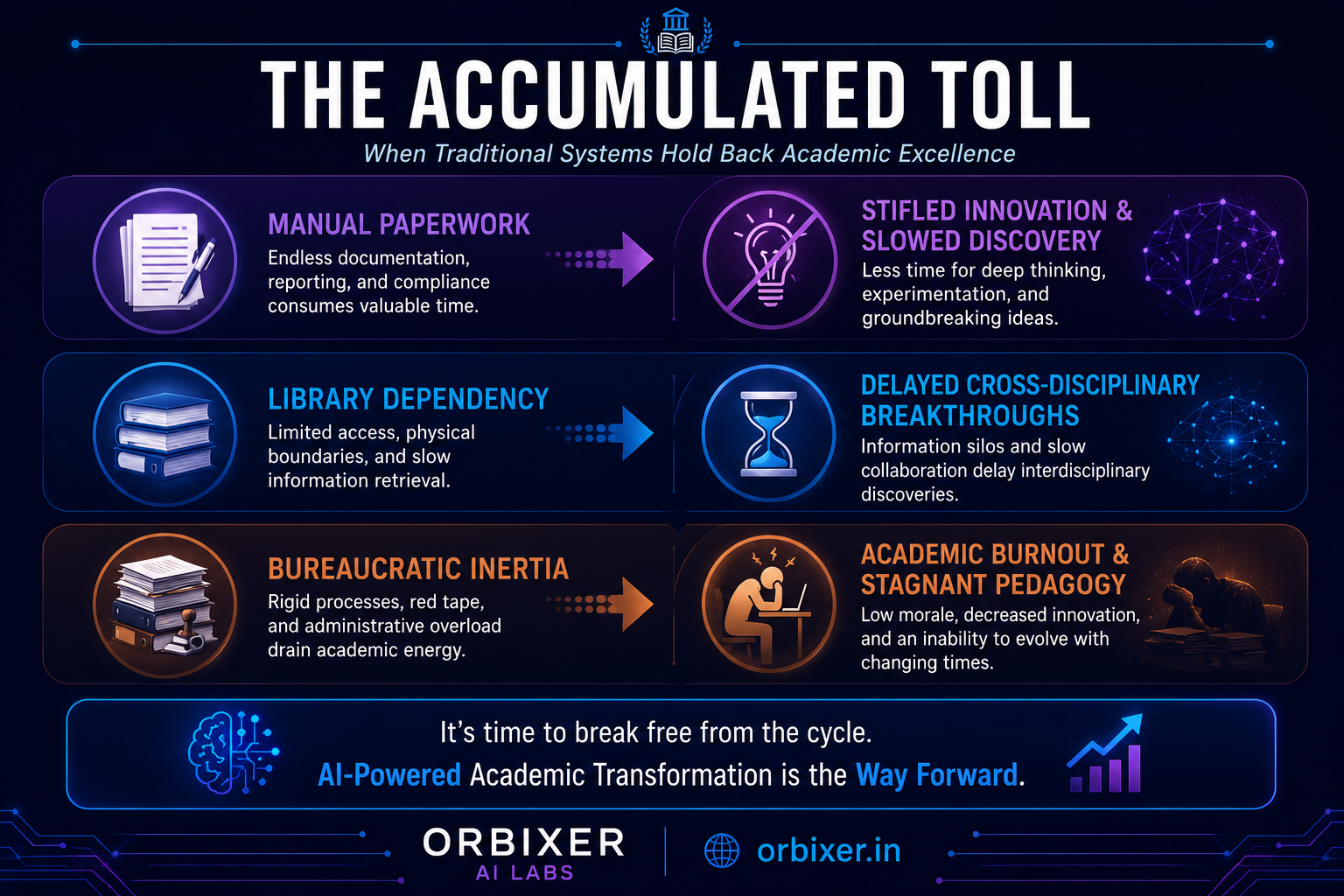
This structural friction created an invisible, devastating emotional tax. The modern professor entered academia driven by a passion for truth, a desire to unlock the secrets of nature, and a commitment to molding the next generation of thinkers. Yet, the realities of the profession systematically ground down that idealism.
According to a longitudinal study on faculty workloads published shortly before the current AI acceleration, the average university professor worked over fifty-five hours per week. Crucially, less than 18% of that time was spent on actual research, and less than 25% was dedicated to direct student instruction. The remaining majority of their time was consumed by meetings, administrative reporting, document formatting, and grading.
"We have industrialized the process of enlightenment. In doing so, we have turned our most brilliant cultural assets—our professors—into managers of academic bureaucracy."
This old world, for all its historic dignity, was fundamentally unsustainable. It relied on the intellectual martyrdom of the educator. It was a world where a single breakthrough paper took years to move from concept to publication, where global knowledge was compartmentalized, and where student feedback was delayed by weeks due to sheer human cognitive limitations.
The burden was not just professional; it was deeply personal. It was felt in missed family dinners, abandoned passion projects, and a systemic rise in academic burnout that hollowed out the faculty ranks of elite institutions worldwide.
The Present Horizon: The Great Academic Augmentation
We have passed the tipping point. The conversation has shifted away from primitive concerns about automated student plagiarism toward a sophisticated understanding of institutional transformation. Today, AI is behaving as a cognitive infrastructure layer across the most prestigious universities globally. From the lecture halls of MIT and the laboratories of Cambridge to the rapidly evolving digital ecosystems of the Indian Institutes of Technology (IITs), the augmented professor is actively dismantling old constraints.
This revolution is defined by concrete, everyday applications that turn weeks of intellectual labor into minutes of elegant synthesis.
1. Research Intelligence and Advanced Synthesis
The modern literature review has been reimagined. Rather than searching for keywords across fragmented databases, professors now deploy advanced AI research copilots. These systems read, map, and contextualize tens of thousands of cross-disciplinary papers simultaneously.
They do not simply return a list of links; they construct conceptual maps, identifying hidden contradictions between a biological study in Tokyo and a material science discovery in Munich. For example, medical faculty are utilizing specialized AI models to scan vast corpuses of oncological data, instantly surfacing obscure drug-interaction profiles that would take a human researcher months of manual reading to discover.
2. Radical Pedagogical Agility
Preparing an elite-tier lecture series has historically required weeks of deep curation. Today, professors utilize intelligent frameworks to generate sophisticated instructional foundations instantly. An engineering professor can input a core concept—such as fluid dynamics in urban architecture—and receive an optimized syllabus, complete with hyper-realistic simulated case studies, interactive python code blocks for student labs, and customized presentation outlines tailored to diverse learning speeds.
This is not automated, generic content; it is high-fidelity instructional scaffolding that the professor can instantly refine, elevate, and infuse with their personal expertise.
3. Precision Assessment and Diagnostic Feedback
The traditional grading process is undergoing a compassionate revolution. Automated assessment systems, engineered with strict rubric alignment, can analyze complex student essays, computer science code, or mathematical proofs in seconds. Crucially, these tools do not merely assign a cold numerical grade. They generate exhaustive, deeply empathetic, and constructive feedback for every student, identifying specific cognitive gaps and suggesting tailored remedial reading.
The professor is no longer a bottleneck for student growth; instead, they step into the room as a diagnostic mentor, armed with real-time analytics highlighting exactly which concepts the class has mastered and which require intervention.
4. Demilitarizing Institutional Compliance and Accreditation
One of the most exhausting aspects of higher education is the endless cycle of accreditation and compliance reporting (such as NAAC, NMC, or ABET documentation). This process forces elite researchers to spend hundreds of hours cross-referencing curriculum maps, faculty outputs, and student performance metrics.
Advanced AI systems developed by innovation ecosystems like ORBIXER AI LABS can seamlessly ingest an institution's unstructured data streams, automatically map them to complex regulatory rubrics, flag compliance anomalies with predictive accuracy, and generate pristine, auditable institutional reports. What once paralyzed an entire department for a month is now resolved quietly in the background.
5. Democratizing Global Publication
Language should never be a barrier to genius. For brilliant researchers across the global south, non-native English fluency has historically been a significant barrier to entry for top-tier international journals. AI-driven language refinement systems act as world-class academic editors. They do not merely correct basic grammar; they optimize the rhetorical flow, align the tone with specific journal conventions, and ensure that the core intellectual contribution shines through with absolute clarity.
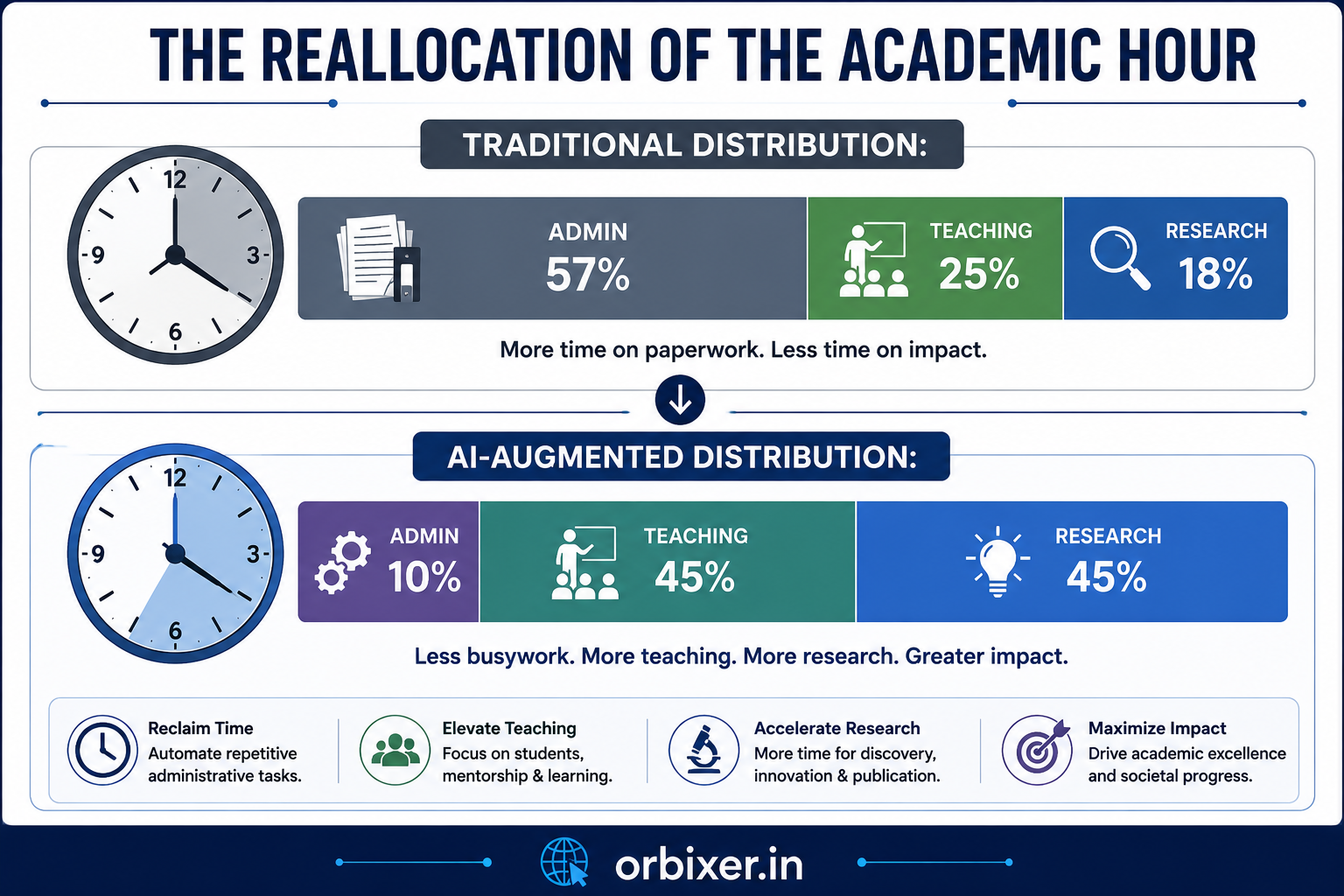
The global data confirms that this is not an isolated trend—it is a macroeconomic shift. Recent educational research highlights a profound reallocation of academic effort:
Impact Metric
Impact Metric | Traditional Framework | AI-Augmented Framework |
Literature Review Synthesis | 3 to 6 Weeks | 45 to 90 Minutes |
Syllabus & Lecture Scaffold Design | 15 to 30 Hours | 20 Minutes |
Accreditation Document Assembly | Multi-Departmental Weeks | Real-Time Continuous Streams |
Individual Student Feedback Cycle | 7 to 14 Days | Instantaneous Diagnostic Readouts |
Overall Faculty Burnout Incidence | ~62% Reporting Chronic Fatigue | ~18% in Early-Adoption Cohorts |
Market intelligence reports indicate that the global AI in education sector is expanding at an unprecedented compound annual growth rate (CAGR) of over 36%. This growth is driven by university leadership teams who recognize that institutional prestige is directly tied to faculty productivity.
Universities that provide their professors with advanced AI ecosystems are seeing measurable surges in high-impact journal publications, faster grant acquisitions, and a sharp increase in student retention rates.
Day in the Life: The Augmented Professor of the Future
To truly appreciate this transformation, we must step out of the present and project ourselves into the daily life of an augmented professor operating at the peak of their potential. Let us follow Dr. Marcus Vance, a Professor of Bioengineering at a forward-looking university powered by an integrated AI academic ecosystem.
08:30 AM – The Cognitive Dashboard
Dr. Vance enters his office. He does not open a chaotic, overflowing email inbox. Instead, his secure academic AI dashboard presents a synthesized overview of his day. The system highlights three critical student interactions that require his personal, empathetic attention based on an analysis of assignment submission patterns.
It also notes that a major international research funding agency has just announced an unexpected, hyper-specific grant opportunity for which his laboratory is uniquely qualified.
10:00 AM – The Intelligent Classroom
Dr. Vance steps into his lecture hall. Today’s topic is complex molecular modeling. Instead of showing static slide presentations, Vance activates the classroom's spatial AI rendering engine. As he speaks, the AI visualizes complex protein-folding structures in real-time, hovering in three-dimensional space behind him.
When a student asks a highly creative, speculative question—"What happens if we introduce a synthetic carbon isotope at the third binding site?"—Dr. Vance does not have to say, "Let me look into that."
He prompts the classroom AI system to run a live predictive simulation. Within seconds, the screen displays the thermodynamic result, allowing the entire class to witness a live, spontaneous scientific experiment. Education transitions from the passive consumption of historical facts to the active exploration of live ideas.
Traditional Learning:
02:00 PM – The Autonomous Research Copilot
In the afternoon, Vance turns his attention to his upcoming paper for a premier journal. His AI research partner has been running continuously in the background for weeks, tracking global clinical trial updates. It alerts him that a laboratory in Kyoto has just published a datasets that perfectly bridges an unresolved gap in his own research.
The AI compiles the raw data from both labs, ensures methodological compliance, checks for subtle inconsistencies, and generates a comparative analysis draft. Dr. Vance spends his afternoon doing what humans do best: interpreting the philosophical implications of the discovery, refining the conceptual narrative, and designing the next phase of human validation.
04:30 PM – The Multiplier Effect
By late afternoon, Dr. Vance has reviewed the AI-generated first draft of his grant application. The platform has cross-checked the budget allocations against the funding body's shifting priorities, ensuring absolute compliance with current financial guidelines.
He approves the submission. He looks at his watch. It is before five o'clock. His administrative tasks are complete, his student feedback is delivered, his research is progressing at an exponential pace, and he is leaving the campus with a clear mind, ready to spend a quiet evening with his family.
He has not worked harder than his predecessors. He has worked with profound, leveraged scale. Through the power of his integrated AI ecosystem, he has performed the work of an entire traditional research institute, all while maintaining his health, his sanity, and his deep devotion to his students.
The Irreplaceable Soul: Human + AI Collaboration
In painting this vision of an AI-driven academic ecosystem, we must confront an undercurrent of anxiety that ripples through university faculty lounges: Will this technology make the human professor obsolete?
The answer is absolute and uncompromising: No. It will liberate them.
Artificial Intelligence is a magnificent engine of synthesis, pattern recognition, and velocity. But it possesses neither a soul nor a conscious spark. It can map every educational theory ever written by human thinkers, but it can never look into a struggling student's eyes, perceive the subtle shadow of self-doubt, and deliver the precise, life-altering word of personal encouragement that changes a young career forever.
AI can draft a flawless literature review, but it cannot experience the raw, intuitive leap of creative genius that transforms a strange anomaly in a laboratory into a revolutionary scientific movement. It cannot embody the ethical anchor that guides a university through complex societal transformations. It cannot replace the sacred, deeply human mentorship that lies at the heart of higher education.
"AI is an extraordinary telescope. It allows us to see deep into the vast universe of human knowledge. But it can never replace the astronomer who decides where to look, who wonders why the stars exist, and who teaches the next generation to look up."
When we look closely at the history of human progress, we see that technological leaps do not destroy human professions; they refine them. The invention of electronic spreadsheets did not eliminate accountants; it freed them from manual arithmetic and allowed them to become strategic financial advisors. The introduction of digital diagnostic tools did not replace physicians; it elevated them into precision healers.
Similarly, AI will not replace professors. Instead, it will strip away the layers of non-intellectual administrative labor that have suffocated the academic profession for generations. It acts as an amplifier, transforming the professor from a manager of administrative systems into an inspired intellectual leader.
By automating the mechanical elements of teaching and research, AI restores the professor to their truest, most noble calling: serving as a catalyst for human potential.
The Responsible Academy: Challenges, Ethics, and Integrity
Every powerful technological leap carries real structural risks. A visionary embrace of Artificial Intelligence requires an equally rigorous commitment to systemic responsibility, academic integrity, and intellectual vigilance. The rapid adoption of AI across higher education introduces several critical challenges that the academic community must proactively address:
The Trap of Intellectual Atrophy: If a researcher relies blindly on an AI system to synthesize literature without ever engaging in deep, unassisted reading, they risk losing the capacity for critical, independent thought. AI must be utilized as an intellectual accelerator, not a substitute for rigorous personal evaluation.
The Hallucination Vector: Large language models are probabilistic engines, not absolute truth verifiers. They can generate highly convincing, elegant citations to papers that do not exist. An augmented professor must maintain a stance of disciplined skepticism, utilizing specialized verification frameworks—such as those engineered by ORBIXER AI LABS—to ensure every data point, reference, and claim is thoroughly cross-verified against verified empirical records.
The Preservation of Academic Integrity: As students gain access to increasingly sophisticated generative tools, traditional forms of home-assignment assessment become obsolete. Professors must lead the transition toward novel evaluation methodologies—emphasizing viva-voce examinations, live project defenses, collaborative problem-solving simulations, and critical analyses of AI-generated outputs.
The Algorithmic Mirror Effect: AI models are trained on historical human data, which means they can inadvertently mirror, encode, and scale historic cultural biases or flawed scientific assumptions. The academic community must act as an independent editorial guardrail, continuously scrutinizing algorithmic recommendations for systemic bias or conceptual stagnation.
Addressing these challenges requires a commitment to deep AI Literacy. Universities cannot afford to ignore these tools or ban them behind unenforceable, defensive institutional policies. Instead, academic leaders must design comprehensive frameworks for ethical AI collaboration, training faculty and students alike to interact with these tools responsibly, transparently, and with absolute intellectual honesty.
The Great Transformation: A Call to Academic Leadership
We stand at a profound historical crossroads. The traditional, industrial-era academic operational model is fractured. The administrative burdens are growing heavier, global knowledge is expanding at an unmanageable velocity, and the demands of a changing student body are shifting rapidly.
To continue working within the old, un-augmented framework is not a sign of traditional academic dedication; it is an active choice to let intellectual potential be consumed by bureaucratic friction.
At ORBIXER AI LABS, we do not view Artificial Intelligence as a collection of disjointed software tools. We see it as a next-generation AI research and academic innovation ecosystem—a cognitive infrastructure designed explicitly to restore the dignity, speed, and creative freedom of the global scholar.
Our commitment is to build secure, highly verified, and deeply ethical AI environments where human intuition can collaborate with machine intelligence to accelerate scientific discovery and human learning.
This moment demands a bold, visionary shift in mindset from deans, researchers, policymakers, and individual professors:
For individual professors: Embrace AI as your intellectual copilot. Allow it to shoulder your administrative burdens, format your papers, optimize your syllabi, and organize your files, so you can step back into your classroom and laboratory with a clear, creative mind.
For university leaders: Provide your departments with the cognitive infrastructure they need to thrive. The prestige of tomorrow’s university will not be measured by the size of its physical libraries, but by the intellectual leverage of its faculty.
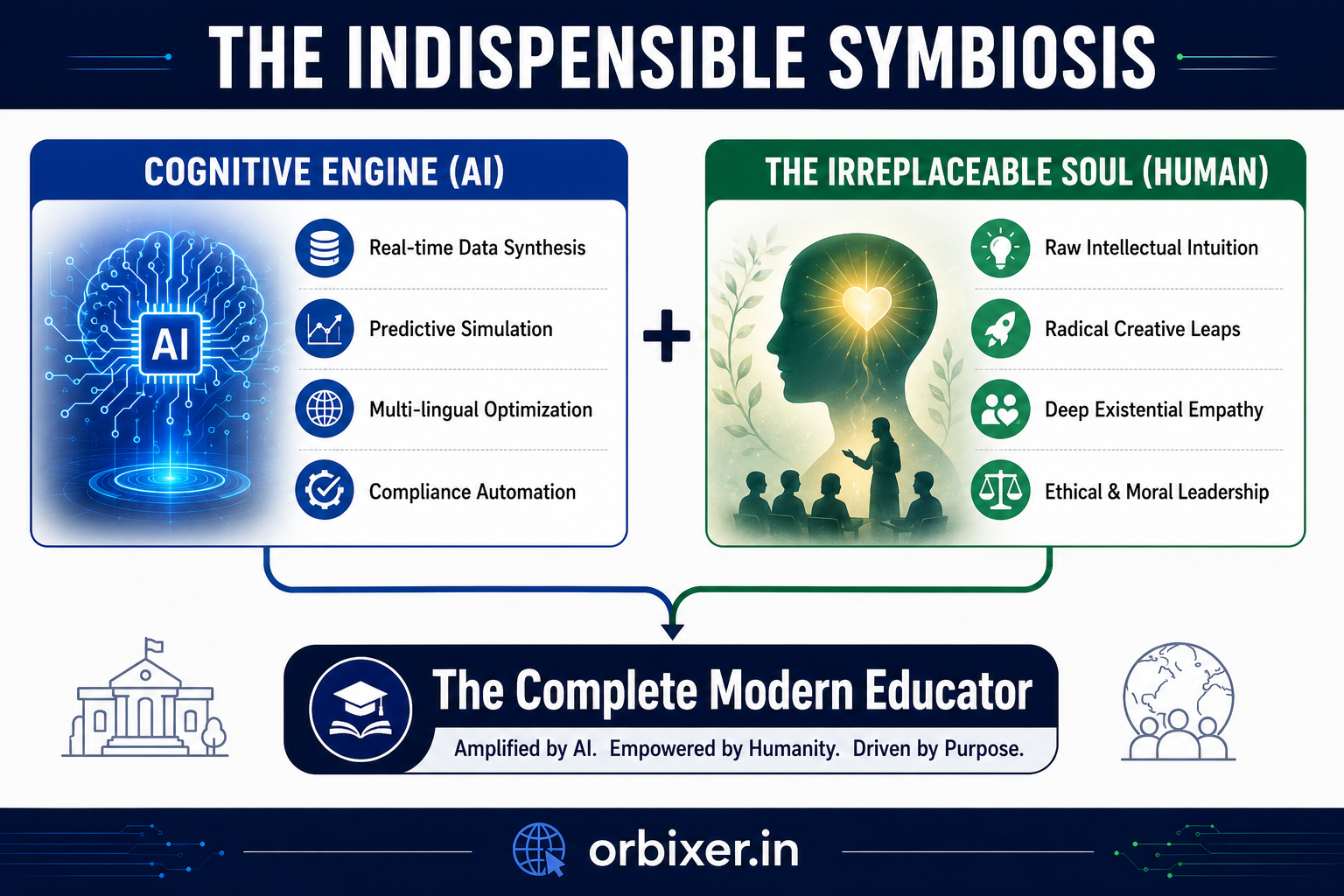
The choice before us is clear, beautiful, and urgent. We can remain tethered to an operational model that rewards endurance over innovation, or we can step forward into an era of profound intellectual amplification.
Let us choose to look forward. Let us unlock the captive genius within our global universities, strip away the weight of administrative inertia, and step into a world where human inquiry is amplified by machine intelligence.
The future belongs not to professors who resist AI, but to those who learn how to lead with it.
Connect with the Future of Higher Education
Is your university prepared to lead the cognitive revolution? Explore how ORBIXER AI LABS is partnering with elite global institutions to engineer secure, ethical, and high-impact AI academic ecosystems that multiply faculty productivity and accelerate scientific discovery. Join the movement at orbixer.com.
About the Author
Dr. Samir Mishra
Managing Director, ORBIXER AI LABS