India's Universities and Research Papers: The Real Numbers, Explained Simply
· Dr. Samir Kumar Mishra

If you have ever wondered how many colleges and universities India really has, or how many research papers Indian scientists publish every year, you are not alone. These numbers get repeated so often, in so many different versions, that most people do not know which ones to trust anymore. Some people say India has 70,000 institutions. Others say 11,000. Some say a huge share of Indian research is fake. Is any of this true?
This blog breaks down the real, verified numbers in plain language. No jargon, no guessing. Every number here comes from a government report, a respected international agency, or a published research study. We will look at three things: how many colleges and universities India actually has, how many research papers India produces every year, and how big the problem of fake or low-quality research journals really is. By the end, you will have a clear, honest picture of where India stands today.
Part 1: How Many Colleges and Universities Does India Have?
Let us start with the basics. India runs one of the largest education systems in the world. But the exact numbers often get mixed up.
The most trusted source for this data is something called AISHE, which stands for the All India Survey on Higher Education. It is published by the Ministry of Education, Government of India. Every few years, this survey counts every university, college, and similar institution in the country.
The latest full AISHE report is from 2021-22. Here is what it actually says: there are 1,168 universities or university-level institutions in India, 45,473 colleges, and 12,002 standalone institutions, which include things like polytechnics, nursing colleges, and teacher training institutes. Add these three numbers together, and you get 58,643 total institutions. That is the real, verified figure.
The real number is 58,643 institutions in total — not 70,000. The ‘11,000+’ figure, however, is accurate. |
So where does the “70,000 institutions” number come from? Most likely, it is a mix-up. Some people may be combining colleges with school-level institutions, which are a completely different category. Others may be using an old or unverified estimate. Whatever the source, it does not match any official government total. The real college number is 45,473, not 70,000 plus.
The ‘11,000 plus’ figure, on the other hand, is accurate. It matches the Standalone Institutions category almost exactly: 12,002 registered, with 10,576 of them actually responding to the survey.
Here is the full breakdown:
Institution Type | Registered | Responded | Response Rate |
Universities | 1,168 | 1,162 | 99.5% |
Colleges | 45,473 | 42,825 | 94.2% |
Standalone Institutions | 12,002 | 10,576 | 88.1% |
Total | 58,643 | 54,563 | 93.0% |
A few more interesting details from the same report. Out of all the universities, 685 are run by the government (either central or state) and 483 are private. Private universities have grown a lot in recent years; they now make up about 40 percent of all universities. The system also has 17 universities and over 4,400 colleges that are exclusively for women.
In terms of people, the system is enormous. There are nearly 16 lakh (1.6 million) teachers working across these institutions, and total student enrollment has crossed 4.33 crore (43.3 million). That is more people than the entire population of many countries.
One quick note: the next AISHE survey, for 2022-23, started collecting data only in January 2024, and a full final report has not been released yet. So 2021-22 remains the latest verified national snapshot. Until a new official report comes out, any claim about a bigger or smaller number should be treated carefully.
It also helps to understand what kind of universities make up this system. About 56 percent of India's universities are described as “general,” meaning they offer a wide range of subjects rather than focusing on one field. Around 16.5 percent are technical universities, 7 percent are medical, and 4.5 percent are agricultural. The rest cover specialized areas like law, management, and pure sciences. If you work in engineering or electronics, as many readers of this blog do, you are part of that technical slice, which has been one of the fastest-growing categories over the last decade.
Another useful detail: Ph.D. enrollment has grown by more than 81 percent since 2014-15, reaching about 2.12 lakh students by 2021-22. This matters because Ph.D. students are usually required to publish research papers to complete their degree, which connects directly to the next two sections of this blog, on how much research India produces and how much of it ends up in questionable journals.
Part 2: How Many Research Papers Does India Publish Every Year?
Now let us talk about research output, meaning the number of scientific papers Indian researchers publish each year.
This data does not come from AISHE. Instead, it comes from international research-tracking organizations like Scopus and the United States' National Science Foundation (NSF). These groups keep track of published research papers from every country in the world, which makes it possible to compare nations directly.
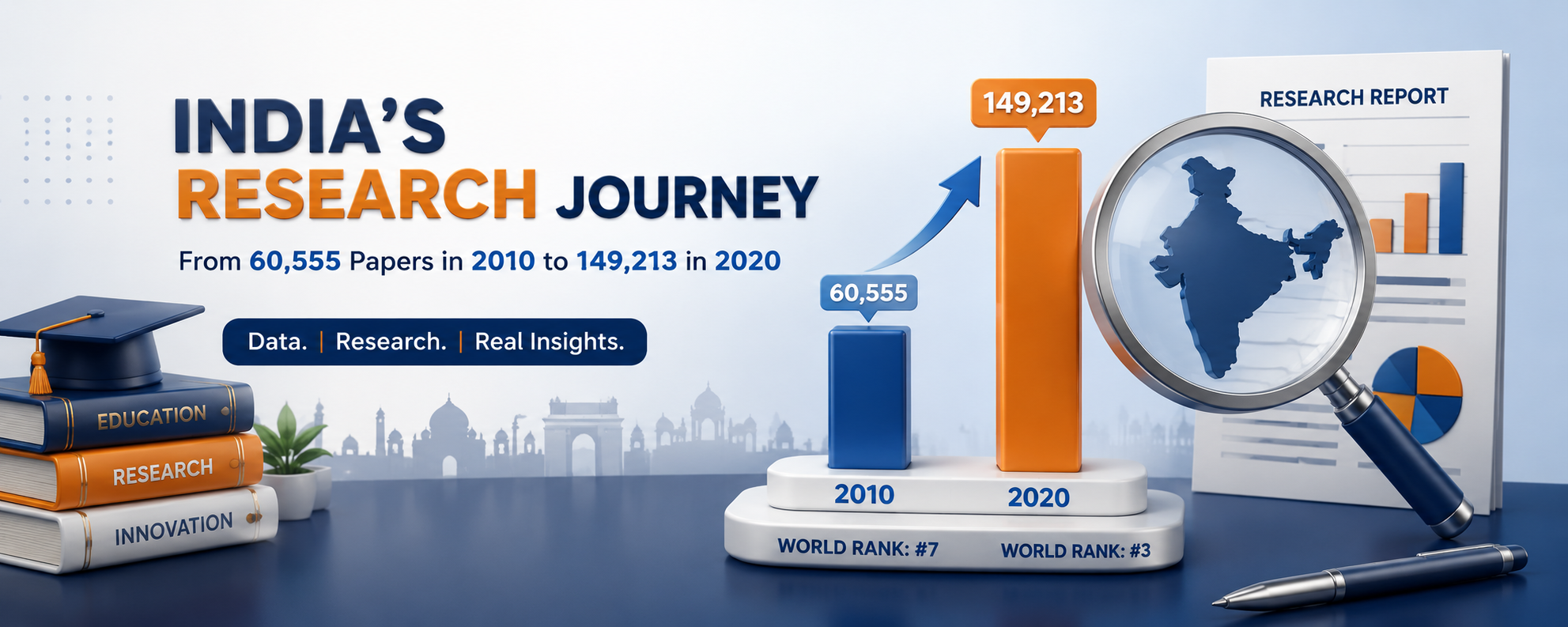
Here is the growth story, and it is genuinely impressive: in 2010, India published about 60,555 research papers in a year and ranked 7th in the world. By 2020, that number had jumped to about 149,213 papers per year, and India's world rank improved to 3rd, behind only the United States and China. That is more than double the output in just ten years, and a jump from 7th place to 3rd place globally.
Source: NSF Science & Engineering Indicators 2022, citing Scopus-classified articles.
What about more recent years, like 2023 to 2025? Here the picture gets a little less precise. There is no single, regularly updated number that tells us exactly how many papers India published in 2024 or 2025. Instead, what we have are newer rankings and quality indicators, which actually tell us something more interesting than just a raw count.
A few highlights from the most recent data: India now has about 19,000 research papers that fall in the “top 10 percent most cited” category worldwide. That is a sign of quality, not just quantity, since these are papers other researchers around the world are actually reading and using. In the Nature Index, which tracks publications in top scientific journals, India climbed to 9th place globally in 2024, overtaking countries like Australia and Switzerland.
When Indian researchers work with international co-authors, their papers get cited 1.4 times more than the world average. This is a meaningful detail. It suggests that Indian research becomes noticeably stronger and more influential when done in collaboration with researchers from other countries.
About 28% of India's research output is in computer and information science — the highest concentration of any major research nation. |
One field stands out above all others: computer and information science. About 28 percent of all Indian research output is in this field, which is the highest concentration of any major research-producing country. If you work in electronics, computing, or anything VLSI and microelectronics related, this is the single fastest-growing and most competitive lane in Indian research right now.
Part 3: The Harder Question — How Much Indian Research Is Fake?
This is the part most people are actually curious about, and it is also the part where we have to be the most careful. There is no single, clean, up-to-date number that tells us “X percent of India's papers are fake.” Anyone who gives you one exact number for this is probably guessing. But there is real, solid data, and it tells an important story.
First, a quick explanation: what is a “predatory” or “fake” journal? It is a journal that pretends to be a real scientific publication but does little or no actual quality checking. These journals often charge researchers a fee and publish almost anything submitted to them, without proper peer review. They exist purely to make money off researchers who need to publish papers for their careers.
Between 2015 and 2017, several independent research teams studied this problem and reached a striking, consistent conclusion: India was the single largest contributor to fake or predatory journal publishing in the world, ahead of every other country studied.
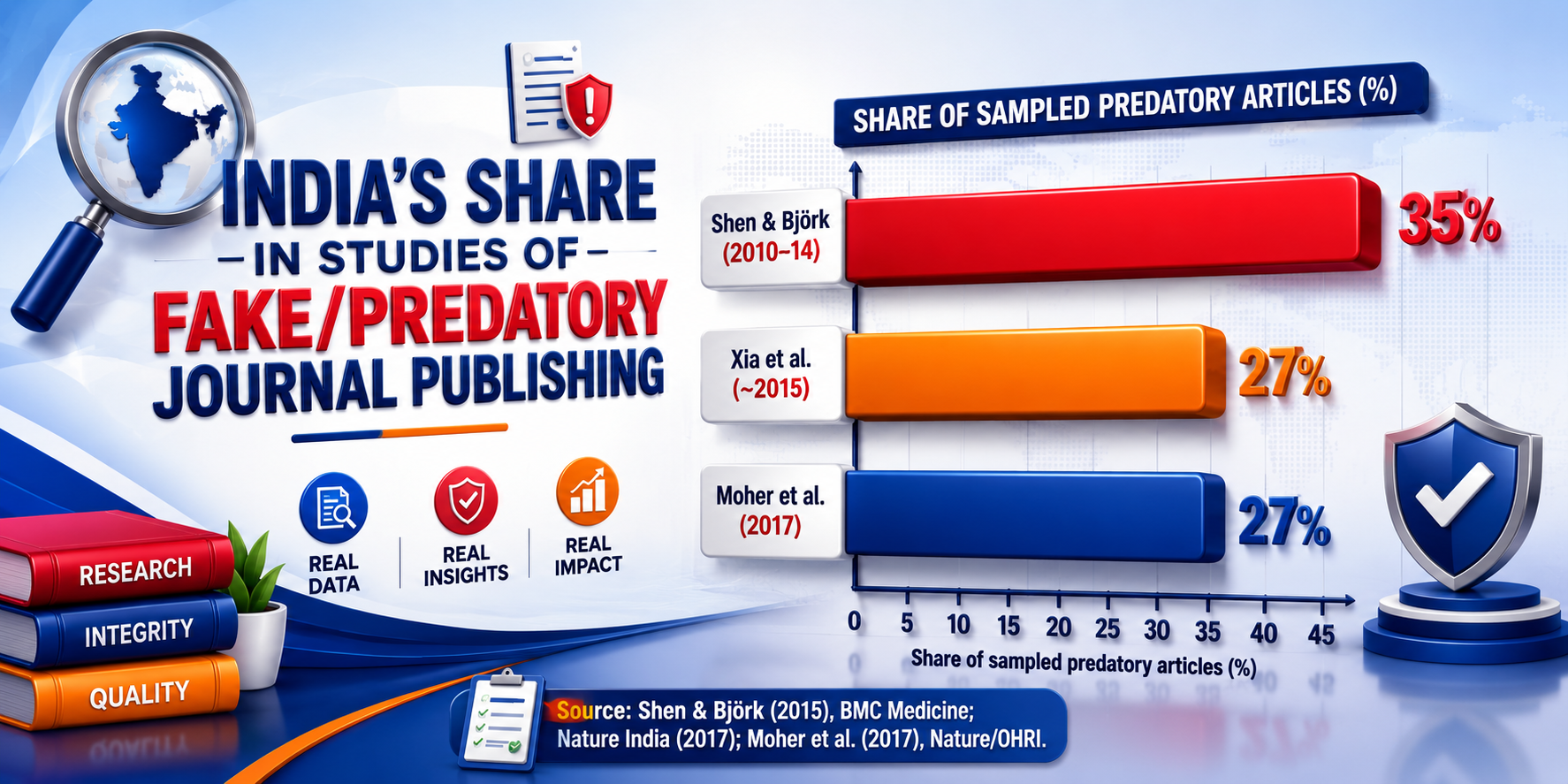
Here are the specific findings: a study by Shen and Björk, covering 2010 to 2014, found that 35 percent of all articles published in fake journals came from India. Another study found that 27 percent of predatory journal publishers were based in India. A study published through Nature, led by researcher David Moher in 2017, looked at nearly 2,000 papers in suspicious medical journals and found that 27 percent of the lead authors were from India. The United States came in second place, but at only 15 percent, far behind India.
Source: Shen & Björk (2015), BMC Medicine; Nature India (2017); Moher et al. (2017), Nature/OHRI.
To put this in context: at the time of these studies, there were roughly 8,000 predatory journals operating worldwide, publishing more than 400,000 papers a year between them. India's share of this problem was disproportionately large compared to its share of the world's population or its share of legitimate research output.
Roughly 9 out of every 10 journals on UGC's own official approved list showed signs of being predatory. |
Even more concerning, an independent check of UGC's own official list of “approved” journals, the very list institutions were required to use, found that only about 11 percent of a sample of 1,009 journals were actually legitimate. In simple terms, roughly 9 out of every 10 journals on India's own official approved list showed signs of being predatory. This was a major wake-up call, and it directly led UGC to remove over 4,300 questionable journals from its list in 2018.
So, has this problem gone away? Partly, but not fully, and the way it has changed is worth understanding.
A 2025 study looked closely at specific Indian universities and tracked how many of their papers appeared in “delisted” journals, meaning journals that were later removed from respected international databases for being low quality. The results show real improvement at some institutions. One well-known institution went from publishing 79.7 percent of its papers in such journals in 2018-19 down to just 8.4 percent by 2023-24. That is a dramatic improvement. Another large university went from 77.3 percent down to 15.1 percent over the same period. Still a lot of papers in questionable journals, but a clear move in the right direction.
However, here is the part that should give everyone pause: even as the percentage of papers in bad journals went down, the number of papers later retracted, meaning pulled back after publication because something was found to be wrong, actually went up sharply at some of these same institutions.
What does this mean in plain English? It looks like the problem did not disappear. It moved. Instead of publishing in obviously fake journals, some researchers shifted toward journals that looked legitimate at first, only for serious problems to surface later, resulting in retraction. This is actually a harder problem to catch, because it does not show up on a simple checklist of “good” and “bad” journals. It requires ongoing monitoring, not a one-time check.
Part 4: A Big Change Nobody Told You About
Here is something genuinely important that most people, even researchers, are not fully aware of yet.
For years, Indian researchers relied on a single government list called UGC-CARE to check whether a journal was trustworthy. If a journal was on this list, it counted toward your Ph.D., your promotion, your academic record. If it was not on the list, it generally did not count.
On 16 July 2025, the University Grants Commission officially shut down this centralized list. In its place, UGC introduced 36 “suggestive guidelines” spread across 8 broad categories, and told every individual college and university to figure out journal quality on their own. There is no longer one official, government-maintained list that tells you, with certainty, “this journal is fine.”
1,168 universities and over 45,000 colleges must now each build their own way of checking journal quality — where before, one shared list did the job. |
Think about what this actually means in practice. India has 1,168 universities and over 45,000 colleges. Each one must now build its own way of checking whether a journal is trustworthy, where before they could simply check one shared list. For a large, well-resourced university, this might be manageable. For a smaller college without a dedicated research office, this is a real and immediate challenge.
This is, in plain terms, a gap. A gap that opened very recently, and one that affects nearly every researcher, professor, and Ph.D. student in the country.
Part 5: What Should Happen Next?
Based on everything above, a few common-sense conclusions emerge.
First, the numbers people repeat casually, like “70,000 institutions,” need correcting. The real figure is 58,643 institutions in total, made up of 1,168 universities, 45,473 colleges, and 12,002 standalone institutions.
Second, India's growth in research output is real and worth being proud of. Going from 7th to 3rd in the world in just a decade, while also improving the quality and citation impact of that research, is a genuine national achievement.
Third, the fake journal problem is real, well documented, and historically large, but it is not frozen in time. Some institutions have made real progress in cleaning up where they publish. The bigger concern now is that the problem appears to be shifting form, moving from obviously fake journals toward later retractions in journals that initially looked legitimate.
Fourth, and most urgently, the recent removal of the centralized UGC-CARE list has created a fresh verification gap at exactly the wrong moment. Just as institutions need stronger tools to monitor research integrity, the one shared national tool they used to rely on has been taken away.
The most sensible path forward is for individual institutions, and ideally the wider research community, to build or adopt ongoing, continuously updated verification systems rather than depending on any single static list, government-issued or otherwise. The data clearly shows that one-time checklists are not enough. What seems to work is continuous, careful monitoring over time.
In Short
India's higher education and research system is enormous, fast-growing, and increasingly influential on the world stage. The verified numbers back this up clearly: 58,643 institutions, a publication output that has more than doubled in a decade, and a global ranking that keeps climbing.
At the same time, the country has a well-documented history with fake and low-quality journal publishing, one that has not fully disappeared, just changed shape. And right now, India finds itself at an unusual moment: the main safety net for checking journal quality was just removed, and nothing has fully replaced it yet.
Understanding these real numbers, rather than the inflated or vague versions that circulate online, is the first step toward fixing what needs fixing, and being proud of what is genuinely working.
Sources: AISHE 2021-22 (Ministry of Education); UGC public notices, July 2025 & February 2025; NSF Science & Engineering Indicators 2022; Nature Index 2024/2025; Shen & Björk (2015); Moher et al. (2017); Meho (2025) Research Integrity Risk Index.