Fabricated Citations Are Surging in Biomedical Research
· ORBIXER AI LABS
Fabricated Citations Are Surging in Biomedical Research
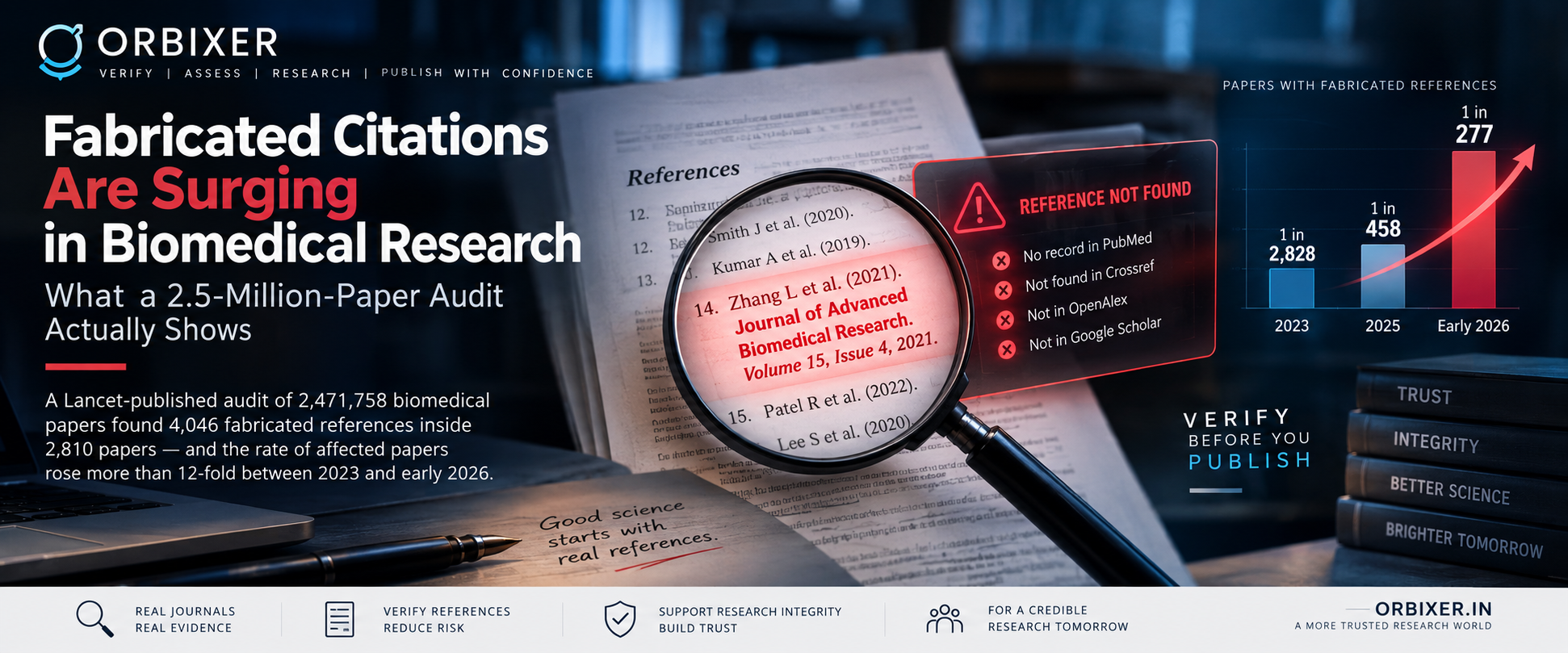
A Lancet-published audit of 2.47 million biomedical papers found 4,046 fabricated references inside 2,810 papers — and the rate of affected papers rose more than 12-fold between 2023 and early 2026.
The assumption science runs on
Peer review does not re-run every experiment it approves. It runs on a narrower, quieter assumption: that a citation points to something real.
A reader does not usually check whether reference #47 exists. Reviewers do not usually verify all 60 entries in a reference list. Editors do not usually re-derive a paper's evidence chain from scratch. The system works because everyone assumes someone upstream already confirmed the sources are real.
A study published in The Lancet in May 2026 shows that assumption is now measurably failing, at a rate that has grown sharply since 2023 [1].
The audit: what was actually measured
A team led by Maxim Topaz (Columbia University School of Nursing, Data Science Institute), with co-authors Nir Roguin, Pallavi Gupta, Zhihong Zhang and Laura-Maria Peltonen, built an AI-assisted verification pipeline and ran it across the PubMed Central Open Access subset — not the whole of PubMed, a distinction the study is explicit about [1,5].
| Metric | Value | Period |
|---|---|---|
| Papers examined | 2,471,758 | 1 Jan 2023 – 18 Feb 2026 |
| Structured references extracted | 125,615,773 | same period |
| References with identifiers, verified | ~97.1 million | same period |
| Fabricated references identified | 4,046 | same period |
| Papers with ≥1 fabricated reference | 2,810 | same period |
| Papers with 3+ fabricated references | 246 | same period |
| System precision (of flagged fabrications) | ~91% | reported by authors |
The verification method itself matters: candidate references were checked against PubMed, Crossref, OpenAlex and Google Scholar; a reference was only labelled "fabricated" if it survived filtering for ordinary bibliographic noise (typos, formatting variants, incomplete metadata) and still could not be located in any of these databases [1]. The authors report precision at ~91%, but validated precision rather than recall — meaning the true fabrication count could be higher than what the audit caught, not lower [8].
The trend is the finding, not the raw count
4,046 fabricated references out of 97.1 million verified is, on its face, a small fraction. The reason this made The Lancet rather than a specialist newsletter is the trajectory [1,4,6,8,9]:
| Period | Papers with ≥1 fabricated reference | Rate per 10,000 papers |
|---|---|---|
| 2023 | ~1 in 2,828 | ~4.0 |
| 2025 | ~1 in 458 | ~51.3 |
| First 7 weeks of 2026 | ~1 in 277 | ~56.9 |
Two further breakdowns, independently corroborated across sources [8,9]:
- 91% of affected papers contained only 1–2 fabricated references; 246 papers had 3 or more.
- Review articles showed a fabrication rate 57% higher than other publication types (16.7 per 10,000 vs. 10.6 per 10,000) — notable because review articles are precisely what other researchers, and eventually clinical guidelines, build on.
- Per STAT News's reporting on the same letter, over one-third of the fabricated citations traced back to just two large open-access publishers — a concentration finding not broken down by publisher name in public reporting [7].
What a "fabricated reference" actually looks like
This is not typo-level sloppiness. The study's own characterization, echoed across independent coverage, is that fabricated references were "not obviously wrong" — topically specific, correctly formatted, and attributed to real researchers who never wrote the cited work [8].
"Your doctor could be making decisions around treatment based on studies that never existed." — Columbia University release [6]
Columbia's own release cites one example: a paper found to contain 18 fabricated references out of 30 total, with some already propagating into systematic reviews that inform clinical practice [6]. Topaz himself, describing his own experience checking a citation, said:
"I was deeply embarrassed: I checked for that, and it still almost happened to me." — Maxim Topaz [7]
The preprint pathway: a second, related finding
A follow-up paper by the same core team, published in the Journal of Internal Medicine (DOI: 10.1111/joim.70139), examined fabricated references specifically in medRxiv preprints and reports these appear roughly twice as often as in the peer-reviewed PMC corpus — stated directly in the paper's own title [3].
Correlation, not proof of cause
The authors are explicit that their data shows when the fabrication rate rose, not definitively why [1,8]. Three candidate mechanisms are named in the paper itself: paper-mill activity, intentional misconduct, and uncritical use of generative AI writing tools — the authors state they "could not determine cause" between these [8].
Independent commentators add nuance rather than certainty: Misha Teplitskiy (University of Michigan) frames the finding as early evidence of "AI slop" entering the literature; Mohammad Hosseini (Northwestern University) frames it as evidence that citation practices are becoming more superficial [7].
Fabricated references increased sharply during the same period generative AI tools became widely available. AI hallucination is a plausible contributor. It has not been shown to be the sole, or even the dominant, cause for every fabricated reference in this dataset.
Why this matters more than a citation-formatting problem
A citation is not decoration. It is a claim that evidence exists. Biomedical evidence typically flows through a chain:
A fabricated reference introduced early in that chain, and not caught, does not stay contained. A review author cites it in good faith. A systematic reviewer may spend real time trying to retrieve a study that was never written. Downstream authors copy the citation without re-checking the original. By the time it reaches a clinical guideline, it looks exactly as credible as every real reference around it.
What this study does not show — limitations, stated plainly
- Covers the PubMed Central Open Access subset only — not subscription-access biomedical journals, and not other fields [1,5,8].
- Measured precision, not recall — the true fabrication rate could be higher than reported [8].
- Cannot attribute any single fabricated reference to a specific cause without further investigation [1,8].
- The granular medRxiv follow-up statistics rest on secondary characterization, not independent confirmation [3].
What researchers, reviewers and publishers can actually do
Authors: treat any AI-suggested citation as a search lead, not a verified source. Open the original publication. Resolve the DOI and confirm it points to the exact title and authors listed — not merely to a paper.
Reviewers: manually verifying 40–100 references per manuscript does not scale. Automated pre-screening — does this DOI resolve, does it match this exact title and author list, does the source exist in Crossref/OpenAlex/PubMed at all — can and should happen before a manuscript reaches a human reviewer's desk.
Publishers: reference-existence checking belongs in the same automated pre-submission pipeline that already screens for plagiarism and image manipulation [1,7].
None of this requires abandoning AI tools in research. It requires treating every AI-suggested citation as unverified until checked against a primary source — the same discipline already expected for a data point or a statistical claim.
The ORBIXER angle: reference verification is a distinct problem from journal verification
The layered verification chain this data points toward:
The first two links are where most existing tools currently concentrate. The last three are comparatively underbuilt — and this audit is direct evidence of why they matter.
The research gap
The Lancet audit answers a question about the PMC Open Access corpus, in biomedical literature, over one specific 38-month window. It leaves open:
- Whether comparable fabrication rates exist in subscription-access biomedical journals, or in non-biomedical fields.
- What proportion of fabricated references trace to AI hallucination specifically versus paper-mill production or deliberate fabrication — the data cannot separate these mechanisms.
- Whether India-specific or other national publication ecosystems show a comparable trajectory — not examined in the published work reviewed here; an open question, not an assumption.
Bottom line
A citation is a claim that evidence exists. A 2.5-million-paper audit, independently corroborated across The Lancet, Nature News, Columbia University, STAT News, CIDRAP and Retraction Watch, shows that claim is being violated at a rate that has grown more than twelvefold in three years — and that fewer than 2% of the affected papers have so far seen any publisher correction. The evidence supports a narrower conclusion than "AI is destroying science": generative AI is a plausible contributor to a real, measured rise in fabricated citations, alongside paper mills and deliberate misconduct — and reference verification is no longer optional at current publication volumes.
References
- Topaz M, Roguin N, Gupta P, Zhang Z, Peltonen L-M. Fabricated citations: an audit across 2·5 million biomedical papers. The Lancet. 2026;407(10541):1779–1781. DOI: 10.1016/S0140-6736(26)00603-3
- Bauchner H, Rivara FP. Fabricated references: a new threat to editorial integrity. The Lancet. 2026. PMID: 42107358. DOI: 10.1016/S0140-6736(26)00798-1
- Topaz M, Zhang Z, Gupta P, Roguin N, Peltonen L-M. Fabricated references are twice as common in medRxiv preprints as in peer-reviewed articles. Journal of Internal Medicine. 2026. PMID: 42444601. DOI: 10.1111/joim.70139
- Retraction Watch. One in 277 PubMed-indexed papers in 2026 shows fabricated references, says analysis. 7 May 2026. Link
- Nature News. Surge in fake citations uncovered by audit of 2.5 million biomedical-science papers. 8 May 2026 (corrected 13 May 2026). DOI: 10.1038/d41586-026-00748-w
- Columbia University School of Nursing / EurekAlert. Nearly 3,000 peer-reviewed medical papers have fake citations, a Columbia Nursing AI-assisted audit finds. 7 May 2026. Link
- STAT News. Fraudulent citations, blamed on AI hallucinations, are becoming more common in research papers. 7 May 2026. Link
- CIDRAP, University of Minnesota. Review uncovers rising rate of fake references in published biomedical papers. 2026. Link
- Practical Neurology. Investigators Find Rising Rate of Fabricated Citations in Biomedical Literature. 2026. Link