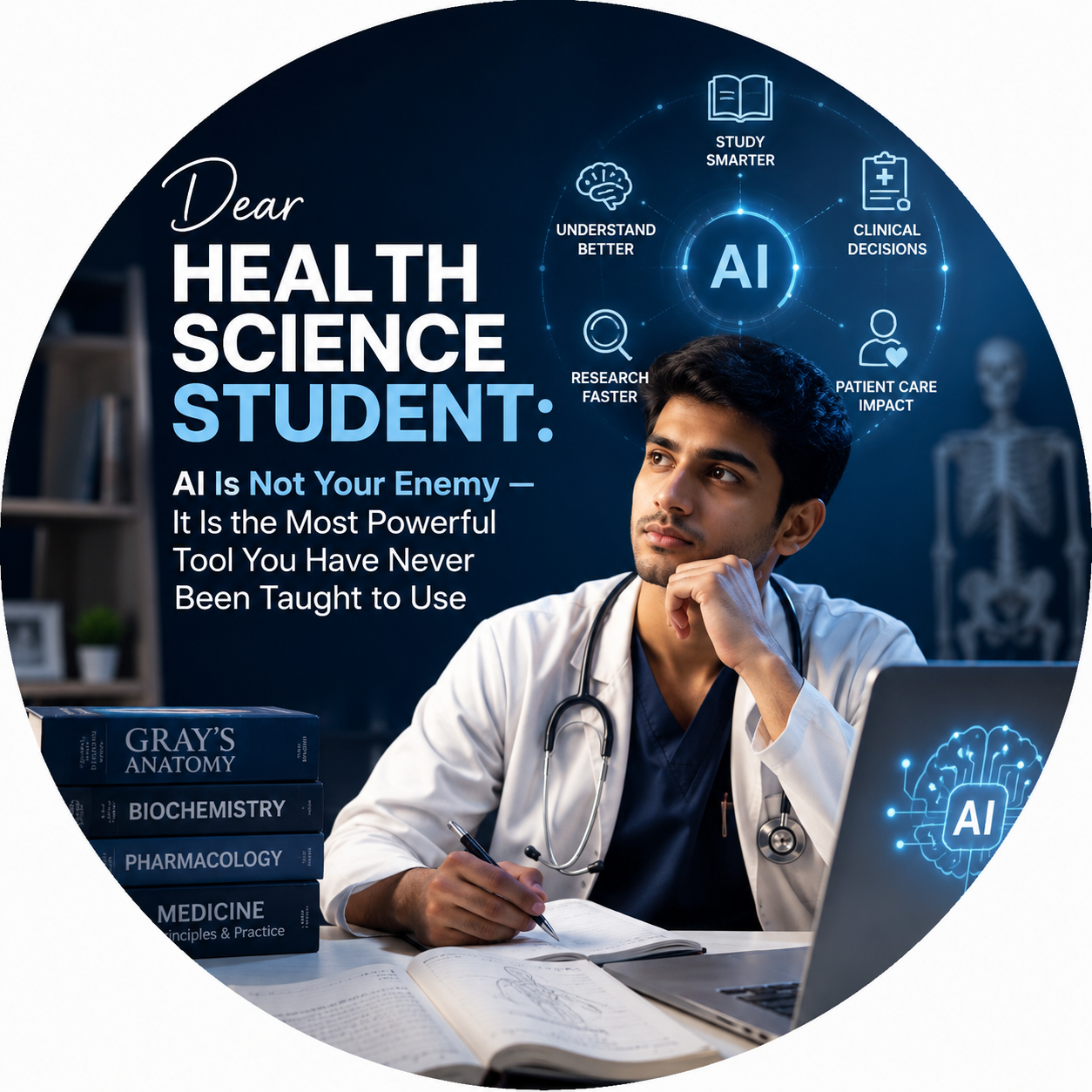
Dear Health Science Student: AI Is Not Your Enemy — It Is the Most Powerful Tool You Have Never Been Taught to Use
· Dr. Samir Mishra
"Sir, everyone is talking about AI. But what does AI actually mean for someone like me — a health science student in India? Can it really help me? Or is it just for computer people?"
That question — asked by a student who had spent three years memorising Gray's Anatomy, struggling through biochemistry, surviving clinical postings — stayed with me for days.
Because the honest answer is this: AI is not just for computer people. AI is for exactly this student. The student who is overwhelmed by the sheer volume of medical knowledge. The student who is trying to keep up with research, clinical skills, patient care, and examinations — all at the same time. The student who feels like the world is moving too fast and nobody gave him a map.
This blog is that map.
The reality of health science education in India today
Let me be completely honest with you about the world you have chosen to enter.
Health science education in India — whether you are studying MBBS, BDS, BAMS, BHMS, B.Pharm, BPT, BSc Nursing, or any allied health science — is one of the most demanding academic journeys any human being can undertake.
“You are expected to memorise thousands of drug names, their mechanisms, their interactions, their side effects. You are expected to understand the human body at the molecular level and the systemic level simultaneously. You are expected to develop clinical judgment — the ability to look at a patient, process dozens of variables in seconds, and make decisions that affect human life.”
And you are expected to do all of this while managing a curriculum that has not fundamentally changed in decades, in institutions where the library closes at 8 PM, with textbooks that are sometimes years behind current medical evidence.
The pressure is enormous. The dropout rate in health science is high. Burnout among medical students in India is a documented public health crisis.
And into this world — already stretched to its absolute limit — comes artificial intelligence.
Not as an additional burden. But as the first genuinely powerful tool that can sit beside you, support you, reduce your load, and help you become a better clinician, researcher, and human being.
What AI actually is — explained for a health science student
Before we go further, let me explain AI in language that makes sense for your world.
Artificial intelligence, at its core, is a system that can learn from large amounts of data and use that learning to recognise patterns, make predictions, and generate outputs — without being explicitly programmed for every single situation.
Think of it this way. A radiologist reads thousands of chest X-rays over twenty years and develops the ability to spot a subtle shadow that suggests early tuberculosis. An AI system trained on a million chest X-rays can develop a similar pattern-recognition ability — and apply it in seconds, consistently, without fatigue.
That is not science fiction. That is happening right now in hospitals across India and the world.
But AI is not just for radiologists. It is not just for surgeons or specialists. It is for you — the student sitting in your hostel room at 11 PM, trying to understand the Krebs cycle, or struggling to write your first research paper, or preparing for your clinical postings with no idea where to begin.
The five biggest problems health science students face — and how AI solves each one
Problem 1 — The information overload crisis
A single medical textbook like Harrison's Principles of Internal Medicine runs to over 4,000 pages. Gray's Anatomy has been published in 42 editions. The pharmacopoeia lists thousands of drugs. In one semester you may be expected to cover anatomy, physiology, biochemistry, and pathology simultaneously.
The human brain was not designed to process this volume of information through passive reading alone.
AI solution: AI tools like ChatGPT, Claude, and Gemini can take any complex medical concept and explain it in plain language, create summaries, generate mnemonics, build comparison tables between similar drugs or diseases, and answer follow-up questions instantly. What used to require three hours of reading and re-reading can now be understood in twenty minutes of focused AI-assisted study.
Problem 2 — Research and evidence-based medicine
Modern medicine runs on evidence. Every clinical decision should ideally be supported by peer-reviewed research. But finding, reading, and synthesising research papers is a skill that takes years to develop — and most health science students in India receive almost no formal training in it.
AI solution: AI tools can search medical databases, summarise research papers, identify the key findings of a clinical trial, explain statistical methods, help you write literature reviews, and even help you identify gaps in existing research that could form the basis of your own study. ORBIXER VERIFY can help you confirm whether the journals you are reading are legitimate and indexed — protecting you from wasting time on predatory publications.
Problem 3 — Clinical skill preparation
The gap between classroom knowledge and clinical application is one of the most frightening experiences in health science education. You know the theory of auscultation — but standing in front of a real patient for the first time, stethoscope in hand, is an entirely different experience.
AI solution: AI-powered simulation platforms allow you to practice clinical scenarios virtually before facing real patients. You can work through differential diagnoses, practice history-taking, review examination findings, and receive feedback — all in a safe, low-stakes environment. This bridge between knowledge and clinical confidence is something traditional medical education has always struggled to provide.
Problem 4 — Ayurveda and traditional medicine research
For students of Ayurveda, Yoga, Unani, Siddha, and Homeopathy — the AYUSH systems — there is a particular challenge. The ancient texts are vast, written in Sanskrit or classical languages, and the modern evidence base for many traditional treatments is still developing.
AI solution: AI can now assist with translation and interpretation of classical Ayurvedic texts, help researchers identify which traditional formulations have been studied in modern clinical trials, cross-reference Ayurvedic compounds with pharmacological databases, and support the development of evidence-based integrative medicine research. For the first time, the bridge between ancient wisdom and modern science has a powerful new tool to help build it.
Problem 5 — Mental health and burnout
I said earlier that burnout among medical students is a documented crisis in India. The hours are long. The stakes feel impossibly high. The culture of medicine often discourages showing vulnerability. Many students suffer in silence.
AI solution: While AI cannot replace human connection or professional mental health support, AI-powered wellness tools can provide round-the-clock access to structured mental health resources, guided breathing and mindfulness exercises, mood tracking, and non-judgmental conversation support. For a student at 2 AM who cannot sleep and cannot call anyone — an AI wellness tool can be a genuine lifeline.
AI in hospitals — what is actually happening right now
Let me take you inside what AI is doing in clinical settings today — because this is the world you are entering as a health science professional.
Diagnostic imaging: AI systems are now reading CT scans, MRIs, and X-rays with accuracy that matches or exceeds experienced radiologists in specific tasks. Google's DeepMind developed an AI that detects over 50 eye diseases from retinal scans. In India, startups are deploying AI for tuberculosis detection in chest X-rays — a critical application given India's TB burden.
Pathology: AI is transforming the analysis of tissue samples. Digital pathology platforms use AI to identify cancerous cells, grade tumours, and flag abnormalities — reducing the time to diagnosis and increasing consistency.
Drug discovery: The time to develop a new drug from discovery to approval traditionally takes 10 to 15 years and costs billions of dollars. AI is compressing this timeline dramatically by predicting how molecules will interact with biological targets, identifying potential drug candidates from vast databases, and predicting toxicity before clinical trials.
Electronic health records and clinical decision support: AI systems integrated into hospital EHR platforms can alert clinicians to potential drug interactions, flag abnormal laboratory values, predict patient deterioration before it becomes visible to the human eye, and suggest evidence-based treatment protocols.
Surgical robotics: AI-assisted surgical systems like the da Vinci Surgical System are allowing surgeons to perform minimally invasive procedures with precision that exceeds the limits of the human hand. AI is now being used to analyse surgical video in real time and provide performance feedback to trainees.
Ayurveda and integrative medicine: Several Indian research institutions and startups are using AI to analyse the pharmacological properties of Ayurvedic herbs, identify synergistic combinations, and build evidence bases for traditional formulations. The government's AYUSH mission has begun integrating digital health tools, and AI is increasingly central to the modernisation of traditional medicine practice.
What this means for you personally
You came to health science because you want to heal people. That has not changed. AI has not changed it.
What AI has changed is the toolkit available to you.
The doctor of tomorrow will not be replaced by AI. But the doctor of tomorrow who does not know how to use AI will be replaced by the doctor who does.
The Ayurveda practitioner who integrates AI-powered research tools into their practice will build an evidence base that commands respect in both traditional and modern medical communities.
The health science researcher who uses AI to identify research gaps, verify journal credibility, and analyse data will publish more, publish better, and build a career faster.
The nursing professional who uses AI for clinical decision support will provide safer, more consistent patient care.
The pharmacist who uses AI drug interaction tools will catch errors that save lives.
This is not the future. This is today. And you are sitting at the beginning of it.
20 best practical AI tools for health science students — start using these today
For learning and understanding:
1. ChatGPT (chat.openai.com) — Explain any medical concept in plain language, generate mnemonics, create study summaries, answer clinical questions. Your 24-hour AI study partner.
2. Claude (claude.ai) — Deeper reasoning on complex medical topics, literature analysis, research writing assistance. Excellent for nuanced clinical and ethical discussions.
3. Gemini (gemini.google.com) — Google's AI assistant, excellent for integrating with Google Docs and searching current medical information. Good for quick clinical lookups.
4. Osmosis (osmosis.org) — AI-powered medical education platform with visual learning, spaced repetition, and clinical case studies specifically designed for health science students.
5. Amboss (amboss.com) — AI-enhanced medical knowledge library and question bank used by medical students globally. Excellent for USMLE and clinical exam preparation.
For research and publication:
6. ORBIXER VERIFY (orbixer.in) — Verify whether any journal is legitimate, indexed, and credible before you submit or cite. Essential for every health science researcher in India.
7. Elicit (elicit.com) — AI research assistant that searches academic databases, summarises papers, and helps you build literature reviews in minutes rather than days.
8. Consensus (consensus.app) — Ask a medical or scientific question and get answers backed by peer-reviewed research. Excellent for evidence-based medicine practice.
9. ResearchRabbit (researchrabbit.ai) — Discover connected research papers visually. Upload one paper and find an entire network of related studies instantly.
10. Semantic Scholar (semanticscholar.org) — AI-powered academic search engine. Better than Google Scholar for finding and filtering health science research.
For clinical skills and diagnosis:
11. Isabel DDx (isabelhealthcare.com) — AI differential diagnosis tool. Enter symptoms and get a ranked list of possible diagnoses with supporting evidence. Used by clinicians worldwide.
12. UpToDate (uptodate.com) — The gold standard AI-enhanced clinical decision support tool. Used in hospitals globally for evidence-based treatment recommendations.
13. Merlin (merlin.founderai.com) — AI clinical assistant for point-of-care decision support, drug information, and patient communication.
14. Human Anatomy Atlas (Visible Body) — AI-powered 3D anatomy visualisation. See every structure, layer, nerve, and vessel in interactive three dimensions. Transforms anatomy study completely.
For Ayurveda and traditional medicine:
15. AyurSearch — AI-powered database of Ayurvedic herbs, formulations, and their documented properties. Cross-references classical texts with modern pharmacological research.
16. TKDL (Traditional Knowledge Digital Library — tkdl.res.in) — India's government database of traditional medicinal knowledge. AI-searchable repository of Ayurveda, Unani, Siddha, and Yoga documentation.
For writing and research documentation:
17. Grammarly (grammarly.com) — AI writing assistant for research papers, case reports, and clinical documentation. Catches errors and improves clarity in medical writing.
18. Zotero (zotero.org) — Free AI-assisted reference management. Automatically collects, organises, and formats citations for research papers. Every health science student needs this.
19. Turnitin / iThenticate — AI-powered plagiarism detection used by most Indian universities and journals. Check your work before submission to ensure originality.
For mental health and wellbeing:
20. Wysa (wysa.io) — Indian-built AI mental health companion. Clinically validated, available 24 hours, and specifically designed for the pressures of high-stress academic and professional environments. For the nights when it all feels too much.
What I told him
That student who walked into my office with his stethoscope and his question — I did not give him a lecture on machine learning. I did not overwhelm him with technical jargon.
I told him: "The patients you will serve in twenty years will be diagnosed by AI tools you have not yet imagined. The research you will read will be synthesised by AI systems that process a million papers in seconds. The treatments you will recommend will be supported by AI models that learn from every patient who has ever had that condition."
"So the question is not whether AI is relevant to you. The question is whether you will be the health science professional who shapes how AI is used — or the one who is shaped by it."
He sat quietly for a moment.
Then he asked: "Sir, where do I start?"
Start with the 20 tools above. Start today. Start with one.
Because the future of healthcare in India will be built by health science professionals who are not afraid of artificial intelligence — but who are curious enough, brave enough, and humble enough to learn how to use it in service of the patient sitting in front of them.
That patient is waiting.
And you — exactly as you are, confusion and all — are exactly the person who can help them.
About the author
Dr. Samir Kumar Mishra is an Associate Professor in Electronics and Communication Engineering at Rama University, Kanpur, with a PhD, Master from IIT Kharagpur. He is the Founder of ORBIXER AI LABS — India's AI-powered research integrity and journal verification platform. He has worked at the intersection of AI, research integrity, and academic mentorship for over 11 years, supporting students across disciplines including health sciences, engineering, and social sciences.
For journal verification, research mentorship, AI detection tools, and academic support — visit orbixer.in or write to info@orbixer.in
Found this useful? Share it with one health science student who is wondering what AI means for their future. You might just change the direction of their career.
© 2026 ORBIXER AI LABS (OPC) PRIVATE LIMITED | orbixer.in