18,000+ Predatory Journals and Rising The Numbers Behind the Scam
· ORBIXER AI LABS
18,000+ Predatory Journals and Rising
The Numbers Behind the Scam
18,000+ Predatory Journals and Rising: The Numbers Behind the Scam
A decade ago, predatory publishing was a fringe problem. Today it is a parallel industry inside academic publishing — one that produces hundreds of thousands of papers a year, collects fees from researchers who often do not know they have been scammed, and keeps growing faster than institutions can track it. This piece walks through the data, why the growth curve looks the way it does, who it actually hurts, and what verification looks like now that the problem has outgrown any single blacklist.
The Headline Number
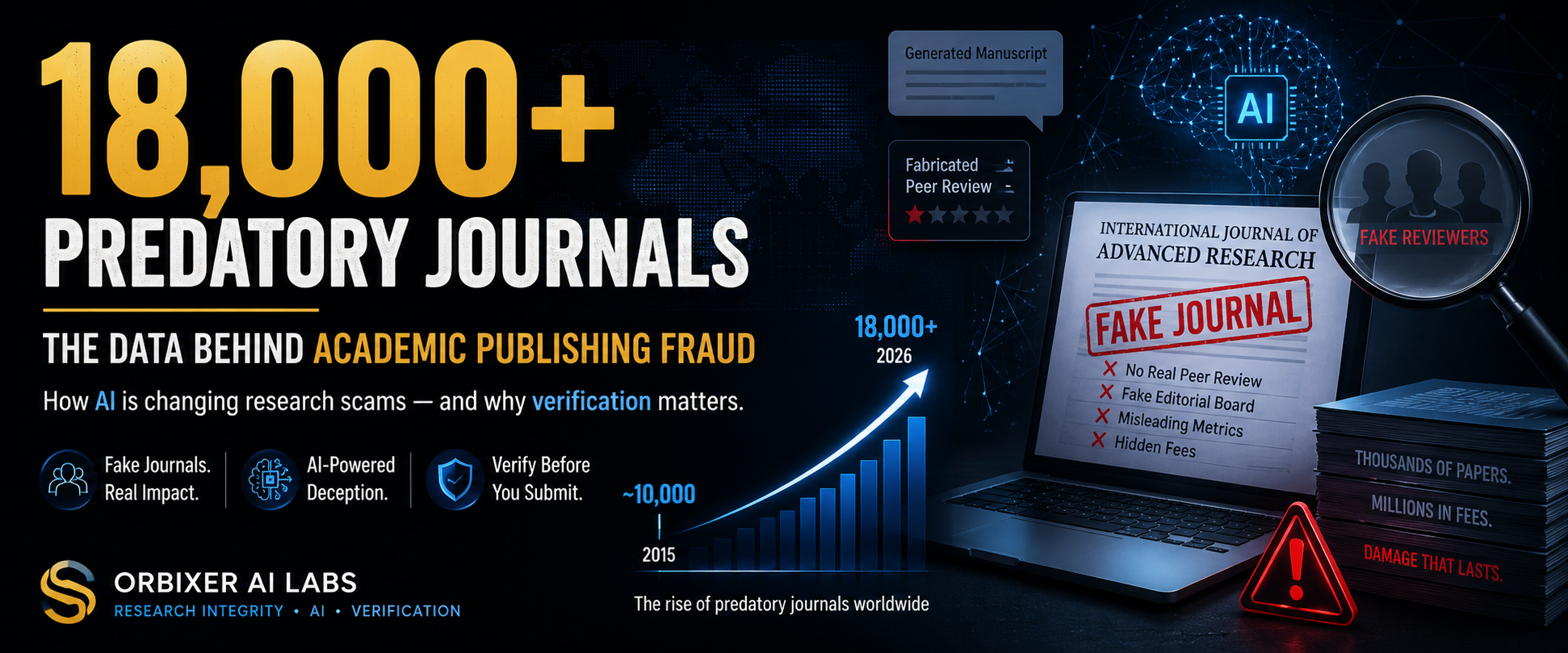
Estimates put the count of predatory journal titles worldwide at over 18,000 as of the most recent counts, up from roughly 10,000 in 2015. That is close to double in under a decade — and the real number is almost certainly higher, because new predatory titles launch faster than watchdog lists can verify and add them.
To put that in perspective, here is what the growth curve looks like:
~10,000 | Estimated predatory journal titles globally in 2015 |
18,000+ | Estimated predatory journal titles globally by the most recent count |
~80% | Approximate growth in predatory titles over roughly a decade |
1,489 | Journals currently flagged as predatory on one actively maintained public tracking list |
100,000s | Approximate number of articles predatory journals collectively publish each year |
No single organisation audits every predatory journal in existence, so every number in that table is a tracked estimate, not a census. Different trackers use different criteria — some count a title the moment it is flagged, others wait for a second confirmation — which is part of why counts vary between sources. What every tracker agrees on is the direction: up, and accelerating.
A Short History: How We Got to 18,000
Predatory publishing is not a new phenomenon — it is a mutation of the open-access model. Legitimate open-access publishing solved a real problem: it let researchers publish without a paywall, funded by an author-side processing fee instead of a reader-side subscription. That model works when the fee funds real peer review and editorial oversight.
Predatory publishers stripped out the expensive part — the actual review and editorial work — and kept the fee. What started as a small number of opportunistic publishers in the early 2010s, when the term "predatory journal" first entered common use, has since scaled into a structured industry with its own marketing playbooks, fake editorial boards, and now, AI tooling. The growth from roughly 10,000 to 18,000+ titles did not happen because oversight failed once — it happened because the underlying economics never stopped rewarding the behaviour.
Why the Number Keeps Climbing
Four forces are driving the growth, and none of them are slowing down.
Publish-or-perish pressure. PhD and faculty promotion rules in many countries still require a fixed number of publications, which creates constant demand for fast, low-friction places to publish — exactly what predatory journals sell.
Sophistication. Predatory publishers now copy the names, websites, and even ISSNs of legitimate journals closely enough that a manual check by a non-specialist is no longer reliable.
Generative AI. This is the newest and fastest-growing driver. AI tools are now being used to generate fake reviewer comments, fabricate peer-review histories, and mass-produce plausible-looking manuscripts, making it far harder to tell a real review process from a simulated one.
Low cost of entry, low cost of failure. Launching a predatory title costs little more than a website and a payment gateway, and getting caught rarely carries any real consequence for the publisher — only for the researcher who submitted to it.
It Is Not Just Obscure Journals Anymore
The damage is no longer confined to journals nobody has heard of. Editorial-integrity researchers now describe a wider structural vulnerability: even journals with a legitimate reputation can be compromised through weak governance, thin oversight, or manipulation by bad actors — without the journal ever intending to be predatory in the first place. Fake peer review and coordinated "paper mill" schemes have been documented inside legitimate-looking editorial pipelines, not just on obviously fraudulent sites.
This matters because it changes the verification question. It is no longer enough to ask "is this journal on a blacklist." The better question is "can this journal's review process actually be trusted, this year, for this submission" — because a journal's status can shift between checks.
This is why organisations such as the Committee on Publication Ethics (COPE) and long-running tracking projects such as Beall's List continue active verification work in 2026 — the fake-journal problem has outgrown any single static blacklist.
The AI Layer: A New Kind of Fraud
Generative AI has changed predatory publishing in two directions at once, and both are worth separating clearly.
On the submission side, AI makes it trivially cheap to mass-produce manuscripts that read as plausible research, increasing the volume predatory journals can process and monetise.
On the review side, AI is now being used to fabricate entire peer-review exchanges — fake reviewer comments, fake revision requests, fake acceptance letters — creating a paper trail that looks like genuine peer review to anyone who does not dig into it.
The second point is the more dangerous one, because it defeats the exact signal researchers are usually told to look for: evidence that a journal actually reviewed the paper. When that evidence itself can be manufactured, the burden shifts from "did this journal review my paper" to "can I independently verify this journal's indexing and metrics through a source the journal itself does not control."
What This Actually Costs a Researcher
The number that matters to any individual researcher is not 18,000 — it is one. One paper, in one predatory journal, does not just fail to count for a PhD or a promotion. It becomes a permanent, discoverable part of that researcher's record. Consequences typically include:
The publication does not count toward PhD, promotion, or grant requirements
Money paid in "processing fees" is not recoverable
The paper cannot usually be withdrawn cleanly once published
Future reviewers, hiring committees, and funders can see it on the researcher's public record
Time lost cannot be recovered — a submission cycle wasted on a predatory journal is a submission cycle not spent on a legitimate one
For early-career researchers specifically, the cost compounds. A first publication in a predatory journal can shape how a hiring or admissions committee reads everything that comes after it, even once the researcher knows better and publishes legitimately.
The Real Problem: Verification Doesn't Scale by Hand
Every credible guide to spotting a predatory journal recommends the same manual checklist: check the ISSN, check the editorial board, check the claimed impact factor against Clarivate or SCImago, check whether the journal is actually indexed where it claims to be. That checklist works — but it takes real time, and it depends on knowing where to look and what a fake indexing claim looks like.
Fake metrics are a specific, well-documented pattern. Predatory journals frequently display invented scores under names like "Global Impact Factor," "Universal Impact Factor," or similar variants — none of which are recognised by Clarivate (Journal Citation Reports) or Scopus (CiteScore, SJR, SNIP). A journal that cites one of these as if it were a real metric is showing a clear warning sign.
This is also where the manual checklist starts to break down at scale. A single researcher checking one journal before one submission can follow ten steps. A university trying to verify the journal history behind thousands of faculty publications, or a research office reviewing submissions across every department every quarter, cannot do that by hand without it becoming a full-time job for someone. That gap — between what individual vigilance can cover and what institutional oversight actually needs to cover — is where most of the failures happen.
Where This Is Heading
Three shifts are worth watching for the rest of 2026:
AI-detection tools are being built specifically to catch AI-generated fake peer reviews, not just AI-generated manuscripts
Peer-review transparency — publishing the review trail itself — is being proposed as a structural fix, not just a detection patch
National and institutional verification systems are decentralising, putting more responsibility on individual universities and researchers to verify journals themselves rather than relying on one central list
That last point is the one with the most immediate impact: verification is moving from something a central authority did for you, to something you are expected to do yourself, every time, before you submit.
A Practical Checklist Before You Submit
None of the above is useful without something to act on. Before submitting to any journal that is not already familiar to your department, it is worth running through this sequence:
Confirm the ISSN on the official ISSN portal, not just on the journal's own website
Verify any claimed impact factor directly on jcr.clarivate.com or scopus.com/sources — never take the journal's own number at face value
Check whether the editorial board members are real, findable, and actually affiliated with the institutions listed
Look for a realistic review timeline — genuine peer review rarely completes in a matter of days
Cross-check the journal against more than one independent verification source, since no single list is complete
The Bottom Line
18,000 is not a static number — it is a floor, and it is rising. The tools scamming researchers have gotten more sophisticated, and in the case of AI-generated fake peer review, they have gotten harder to catch with a manual eye. The single most reliable protection left is verifying a journal's real indexing and metrics before submission — not after, and not by trusting the journal's own website to tell the truth about itself.
Written by Team ORBIXER — IIT Kharagpur Alumni | Founder, ORBIXER AI LABS.
The numbers above are only half the story — learn to spot the predatory journal warning signs yourself before you submit anywhere.